
Accelerating Global Warming Poses Mounting Threats to Potato Production and Supply Chains
Key takeaways
- Warming at 0.35°C per decade since about 2015
- Against 0.2°C per decade from 1970 to 2015
- Confirmed in five datasets, 98%+ confidence
- Heat in tuber formation cuts yield and dry matter
- Reducing sugars darken fries and chips
Why it matters
- For farmers
- Irrigation demand, pest windows and storage cost all move at once — the adaptation is not a single decision.
- For processors
- Reducing sugars are the direct commercial link: warming shows up as fry colour before it shows up as tonnage.
- For investors
- Heat- and drought-tolerant breeding, precision irrigation and storage technology are where the response capital is going.
60-second summary
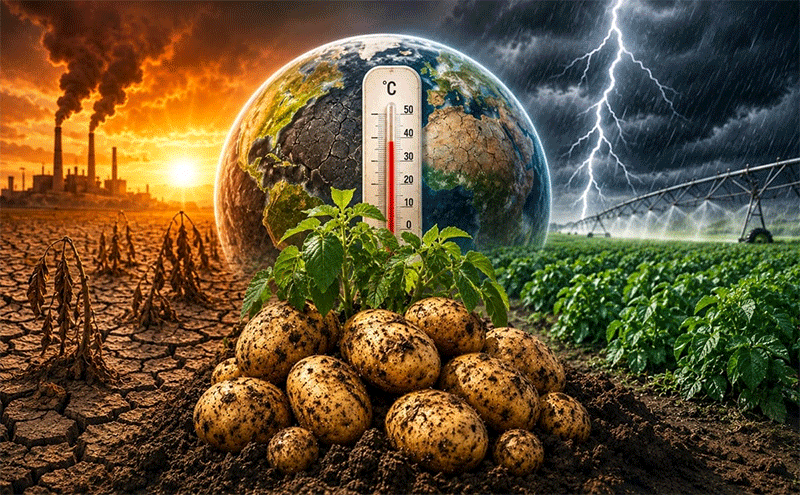
A study from the Potsdam Institute for Climate Impact Research, published in Geophysical Research Letters, finds that global warming has accelerated since around 2015: temperatures are rising at 0.35°C per decade against 0.2°C per decade between 1970 and 2015, confirmed across five independent datasets at over 98% statistical confidence. For potatoes — grown in more than 150 countries with output above 380 million tonnes — this matters more than for cereals, because the crop favours cooler conditions. Heat during tuber formation reduces yield, shortens the season and cuts dry matter accumulation, while promoting secondary growth, cracking and hollow heart and raising reducing sugars that darken fried products. Beyond the field, higher evapotranspiration and erratic rainfall intensify irrigation demand, aphids, psyllids and late blight expand their range, and storage faces higher cooling costs and losses from premature sprouting.
A new climate study from the Potsdam Institute for Climate Impact Research (PIK), published in Geophysical Research Letters, reveals that global warming has not only continued but accelerated since approximately 2015, with temperatures now rising at a rate of 0.35°C per decade—nearly double the 0.2°C per decade observed between 1970 and 2015. This trend, confirmed across five independent datasets with over 98% statistical confidence, carries profound implications for agriculture, particularly for potatoes, a crop cultivated in more than 150 countries with annual output exceeding 380 million tons. Unlike cereals, potatoes thrive in cooler conditions, making them highly vulnerable to heat stress: rising temperatures during tuber formation reduce yields, shorten growing seasons, and diminish dry matter accumulation. Warmer conditions also promote physiological defects such as secondary growth, cracking, and hollow heart, while increasing reducing sugars that darken fried products like fries and chips—directly impacting processing quality and marketability.
Beyond the field, accelerated warming threatens water management, pest dynamics, and post-harvest systems. Higher evapotranspiration rates and increasingly erratic rainfall will intensify irrigation demands, while pests like aphids and potato psyllids—along with diseases such as late blight—are expected to expand their geographic range and activity periods. Storage faces rising cooling costs and greater losses from premature sprouting and respiration under elevated temperatures, while extreme weather events disrupt harvesting, transport, and processing, heightening supply chain volatility. In response, researchers, breeders, and industry players are accelerating investments in heat- and drought-tolerant varieties, precision irrigation, regenerative soil practices, digital monitoring, and advanced storage technologies. Organizations like the International Potato Center (CIP) are fast-tracking breeding programs, while AI and remote sensing offer farmers real-time tools for adaptive management. However, as the PIK study underscores, the pace of warming is quickening, demanding equally rapid and coordinated action across science, policy, and the entire potato value chain to safeguard this essential global food source.
Global Potato Brief
Top five stories, prices, disease alerts and events. Weekday mornings, no advertising.
Sources
- Potsdam Institute for Climate Impact Research (PIK), published in Geophysical Research Letters — named in the article
Linked in this material
Related stories

Russian Potato Farmers Face Twin Crises in 2026: Extreme Weather and Retail Market Discrimination

Extreme Weather Devastates Potato Harvests Across Russia and Kazakhstan, Driving Prices Up


