Uzbekistan: Kazakhstan displaces Pakistan as main potato supplier while exports stay marginal
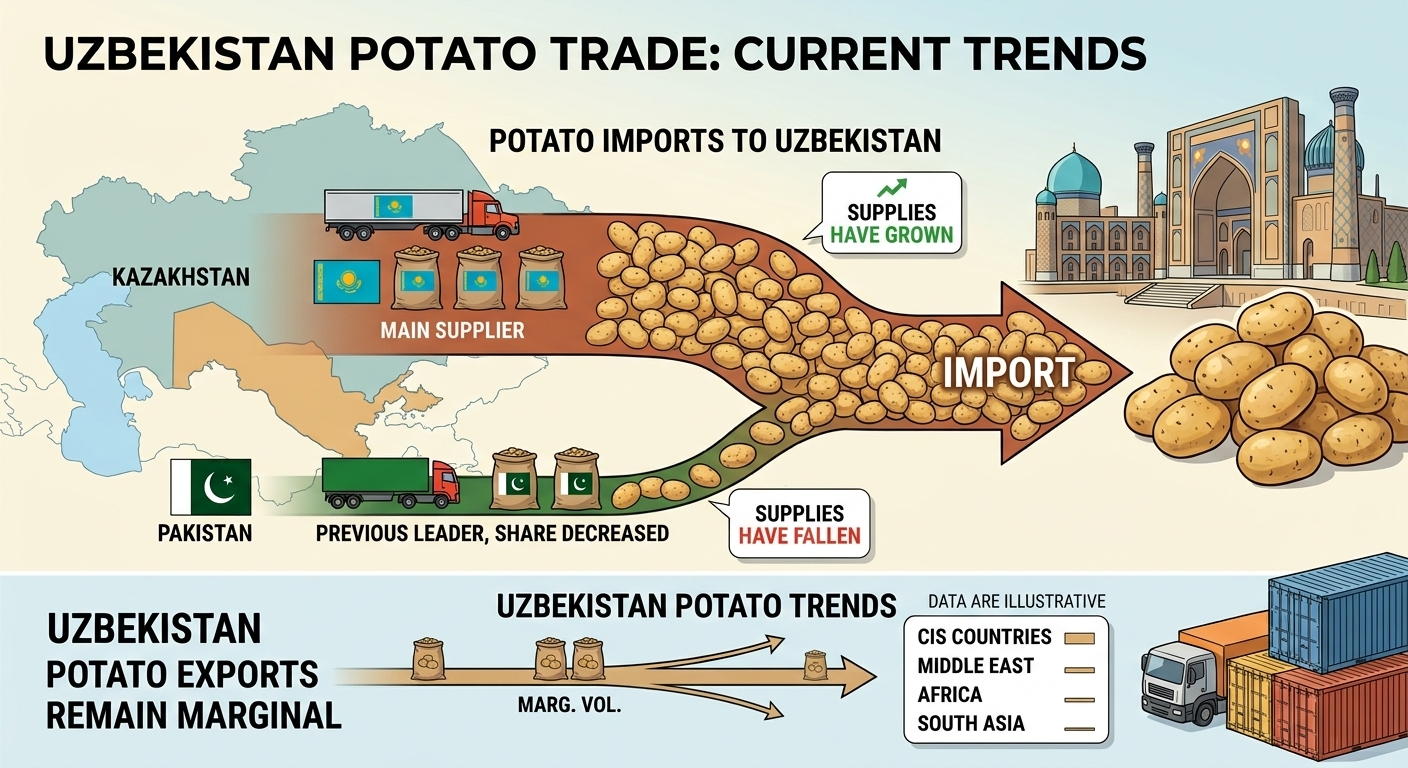
Kazakhstan has become the dominant source of potatoes for Uzbekistan’s market, replacing Pakistan within a single season. Official Uzbek data also point to a near fivefold rise in potato exports this year, but from a very low base: Central Asia’s most populous country remains a net importer by a wide margin.
A shift in supply
According to Uzbekistan’s National Statistics Committee, the country imported 421.9 thousand tonnes of potatoes worth USD 34 million from 11 countries in January–June 2026. Around 80% of that volume came from Kazakhstan.
Kazakh trade data show the same shift from the other side. Kazakhstan shipped 202.8 thousand tonnes of fresh potatoes to Uzbekistan in January–April 2026, 11.8 times the volume for the same period a year earlier. The figure was reported by the Kazakh outlet LS and cited by newtimes.kz.
Weekdays. Unsubscribe in one click.
The change is striking because Pakistan was the leading supplier only a year ago. Of the 490.8 thousand tonnes Uzbekistan imported in January–August 2025, almost 300 thousand tonnes came from Pakistan, according to the statistics committee.
Kazakh supplies surged while total imports fell. This suggests that Kazakh product has taken over much of the volume previously sourced from South Asia rather than simply adding to it.
Overall import volumes are declining. The Ministry of Agriculture reports 419.9 thousand tonnes imported in January–July 2026, down 53.6 thousand tonnes (about 11%) year on year, with the import bill USD 21.5 million lower.
The two government bodies’ figures should not be compared directly. The ministry’s seven-month total is lower than the statistics committee’s six-month total, which indicates differing accounting methods.
Exports: rapid growth, small volumes
The Ministry of Agriculture said Uzbekistan exported 7.2 thousand tonnes of potatoes worth USD 1.5 million in January–August 2026. That is 5.7 thousand tonnes and USD 1 million more than a year earlier, which implies roughly 1.5 thousand tonnes worth about USD 0.5 million in 2025. The figures were reported by the Uzbek news site nuz.uz.
The ministry did not disclose destination markets. Based on the rounded published figures, the average export value works out at around USD 210 per tonne, compared with roughly USD 330 per tonne a year earlier. This should be treated as an indicative estimate only, because the value figures are rounded to the nearest USD 0.1 million.
Even after this year’s growth, exports amount to less than 2% of import volumes.
Production push
The government aims to reduce import reliance by expanding domestic output. The ministry put 2025 production at 4.1 million tonnes and has set a target of 4.5 million tonnes for 2026.
Main-season plantings cover 238 thousand hectares, 46 thousand hectares more than last year. Of this, 74.4 thousand hectares is on commercial farms. The remaining 164.2 thousand hectares is on dehkan farms and household plots, the small-scale family holdings that account for a large share of Uzbek vegetable production.
In August, the ministry had cited a planned area of 284 thousand hectares. It has not explained how the two figures relate.
The first-half harvest from main plantings reached 2.254 million tonnes, 119% of the previous year’s level. Potatoes were also planted as a second crop on 71 thousand hectares after cereals and early crops were harvested, and the authorities expect a further 1.2 million tonnes from this area in November.
To cover the off-season, 400 thousand tonnes have been placed in storage. Of this, 216 thousand tonnes is held in refrigerated facilities and 184 thousand tonnes on farms. A further 262 thousand tonnes is planned for the winter–spring period of 2026–2027.
Prices down
The ministry said the average potato price at dehkan markets (farmers’ markets where small producers sell directly) had fallen to 4,169 soums per kilogram from 5,717 soums a year earlier, a decline of 27.1%. It did not specify the exact comparison period. Farm-gate wholesale prices are 2,500–2,800 soums per kilogram.
Outlook
Lower retail prices alongside shrinking imports are consistent with official reports of a larger harvest. Uzbekistan is nonetheless far from becoming a meaningful exporter, and three factors will shape what happens next:
- Scale. Outbound shipments are two orders of magnitude smaller than inbound ones.
- Supplier concentration. Reliance on Pakistan has largely been replaced by reliance on Kazakhstan rather than reduced.
- The next few months. Much depends on whether the November second-crop harvest meets forecasts and whether stocks prove sufficient to carry the market through spring without a renewed rise in imports.
For exporters in Kazakhstan, and for suppliers elsewhere seeking to regain market share, those spring months will be the key test.
Sources: Ministry of Agriculture of Uzbekistan (via nuz.uz, 7 September 2026); National Statistics Committee of Uzbekistan (via nuz.uz, 26 August 2026; stat.uz); Kazakh bilateral trade data (LS via newtimes.kz). The 2026 export figures rely on a single source, the Uzbek Ministry of Agriculture.
Global Potato Brief
Top five stories, prices, disease alerts and events. Weekday mornings, no advertising.
Linked in this material
- Sections
- News
Related stories

Students of the Institute of Agrobiotechnology Harvest Over 23 Tonnes of Potatoes

China Potato Congress 2026: Official Agenda Stays Domestic as Equipment Makers Pitch a Global Story