US tightens import rules on Prince Edward Island potatoes — but stops short of the ban growers wanted
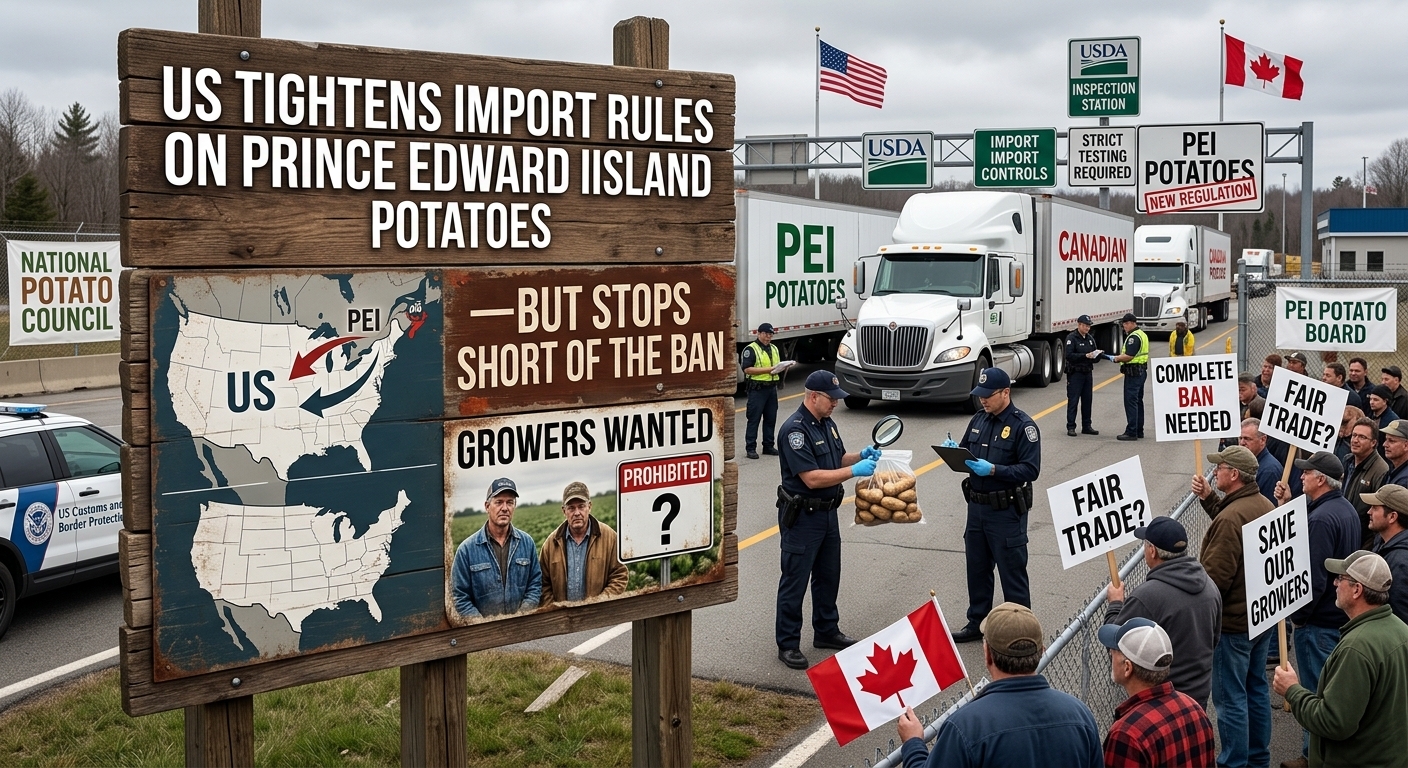
Washington has chosen a middle path in its long-running phytosanitary dispute over Canadian potatoes. Instead of reinstating a ban on fresh potatoes from Prince Edward Island (PEI), as the US industry demanded in May, the USDA’s Animal and Plant Health Inspection Service (APHIS) has issued a new federal order that moves much of the compliance burden onto American businesses buying the island’s crop. The rules take effect on 5 October 2026, just as the PEI harvest reaches the market.
A single field, a new order
The trigger was a detection of potato wart (Synchytrium endobioticum) in April 2026. It was found through analysis of tare soil (the soil that comes off harvested tubers) and led to the registration of a new infested field on the island. The Canadian Food Inspection Agency (CFIA) announced the finding in mid-May. It was PEI’s first detection since 2023. The CFIA said it was confined to one field, with no evidence of spread. It added that the farm grew seed only for its own use and sold its crop to on-island processors, and that the finding did not alter existing controls on moving PEI potatoes.
Potato wart is among the most feared soil-borne diseases of the crop. It causes cauliflower-like galls on tubers. It poses no risk to human health, but it renders potatoes unmarketable, and the CFIA estimates that uncontrolled infestations can cause field losses of 50–100%. There is no chemical or non-chemical treatment, and resting spores can survive in soil for more than 40 years. The US regulates the pathogen as a Select Agent, a designation reserved for plant pathogens considered a severe threat to domestic agriculture. APHIS records 38 infested fields on PEI since the disease was first found in a processing potato field in 2000.
Weekdays. Unsubscribe in one click.
Federal Order DA-2026-28, dated 21 August, supersedes DA-2022-14, the order under which PEI table and processing potatoes have entered the US since 2022.
What changes
The core of the order targets bulk trade. Potatoes shipped in containers of 22.7 kg (50 lb) or more for processing, packing or repacking may be consigned only to US facilities that have signed a compliance agreement with APHIS. Those facilities must handle waste under strict conditions. Culls and waste from processing and repacking may not be fed to livestock or spread on farmland, and must go to an APHIS-approved disposal site. Importing PEI culls for animal feed, or for any other purpose, is prohibited outright.
The feed restriction reflects a specific pathway. According to the National Potato Council (NPC), the pathogen can survive passage through the digestive system of cattle and then persist in soil for decades.
Traceability is the second pillar. Where potatoes arriving in packs under 22.7 kg are repacked in the US, the importer must preserve each shipment’s identity. A unique identifier, linked to the production code on the Canadian phytosanitary certificate, must appear on every package and allow a full trace back to the field, the packing shed and the exporter.
The order also explicitly bars the use of PEI potatoes imported for consumption as seed. Field-grown seed potatoes remain banned, as they have been since 2021. In vitro plantlets, micro-tubers and mini-tubers may still enter under permit.
Existing requirements stay in place. Potatoes must not come from fields restricted under Canada’s response plan. They must be washed free of soil with a forced water stream and treated with a sprout inhibitor registered in Canada. Each consignment must carry a CFIA certificate with an additional declaration and is subject to inspection at the US port of entry. Tubers must meet the US No. 1 grade standard, except for its minimum size requirement. APHIS has acknowledged that US facilities and Canadian exporters need time to adjust, which is why DA-2022-14 remains in force until 5 October.
Two readings of the same detection
On 18 May the NPC and 13 state potato organisations wrote to USDA Under Secretary Dudley Hoskins, urging an immediate return to a ban on fresh PEI potatoes. Their argument was that the new field had no association with previous finds, which in their view raised doubts about the true extent of the disease on the island.
The PEI Potato Board saw it differently. It said the field lay in close geographic proximity to the area linked to earlier detections, and it described the finding as evidence that Canada’s surveillance system was working.
The two positions are not strictly contradictory. A field can lack an epidemiological link to earlier finds, through shared machinery, seed or soil, and still be located nearby. But each side has drawn opposite conclusions about what the detection means for risk.
Despite not getting its ban, the NPC welcomed the August order. Chief Executive Kam Quarles described the measure as long awaited and thanked Agriculture Secretary Brooke Rollins, Under Secretary Hoskins and APHIS. He said it was a further step towards ensuring the disease never became established in the US. Jeannie Tapley, Executive Director of the Maine Potato Board, said that given Maine’s proximity to PEI, the state’s growers strongly supported the action.
Analysis: who bears the cost
The burden falls on the importing side. Most of the new obligations sit with US processors, packers and repackers rather than with Canadian exporters. These include compliance agreements, controlled waste disposal and lot-level identity preservation. APHIS said its review of import data identified bulk potatoes moving to processing and repacking facilities, and the waste they generate, as the pathway requiring additional safeguards.
A cheap disposal route disappears. Feeding culls to cattle is a low-cost outlet for many potato handlers. Mandatory disposal at approved sites will raise costs for facilities handling PEI product. Neither APHIS nor industry bodies have published an estimate of how much.
The timing is tight. With the order taking effect on 5 October, the bulk of the 2026 PEI crop will enter the US under the new regime. Facilities that have not concluded agreements with APHIS by then will be unable to receive bulk loads.
Sourcing could shift. If compliance costs prove material, some US buyers may turn to other Canadian provinces or to domestic supply. This remains a scenario rather than a trend: there is no data yet to indicate such a shift.
Background: a dispute now in its fifth year
The PEI potato wart issue has been a recurring irritant in Canada–US agricultural trade since late 2021. After wart was confirmed in two fields that October, Canada’s agriculture minister issued a Ministerial Order in November suspending certification of PEI potato exports to the US, under pressure from Washington. The provincial government warned at the time that losses would run into hundreds of millions of dollars; that figure was a political estimate rather than official data. Trade in table and processing potatoes resumed in 2022 under DA-2022-14, issued at Canada’s request after confirmatory analysis. The ban on seed potatoes has never been lifted.
In 2025 the CFIA adopted a National Potato Wart Response Plan. The plan widened oversight from PEI to the whole of Canada and revised field categories and phytosanitary measures. The new US order uses that plan’s field classifications to define which PEI potatoes are eligible for export.
The latest episode follows a familiar pattern. Canada maintains that its surveillance works and the finding is contained. US growers press for maximum protection. APHIS settles on an intermediate response. This time the compromise keeps PEI potatoes in the US market, but makes them more expensive for the American businesses that buy them.
Sources: USDA APHIS, Federal Order DA-2026-28 (21 August 2026); Capital Press (19 May and 25 August 2026); Brownfield Ag News (25 August 2026); National Potato Council; CBC News (19 May and 28 August 2026); Agri-Pulse.
Global Potato Brief
Top five stories, prices, disease alerts and events. Weekday mornings, no advertising.
Linked in this material
- Sections
- News
Related stories
Students of the Institute of Agrobiotechnology Harvest Over 23 Tonnes of Potatoes
China Potato Congress 2026: Official Agenda Stays Domestic as Equipment Makers Pitch a Global Story