
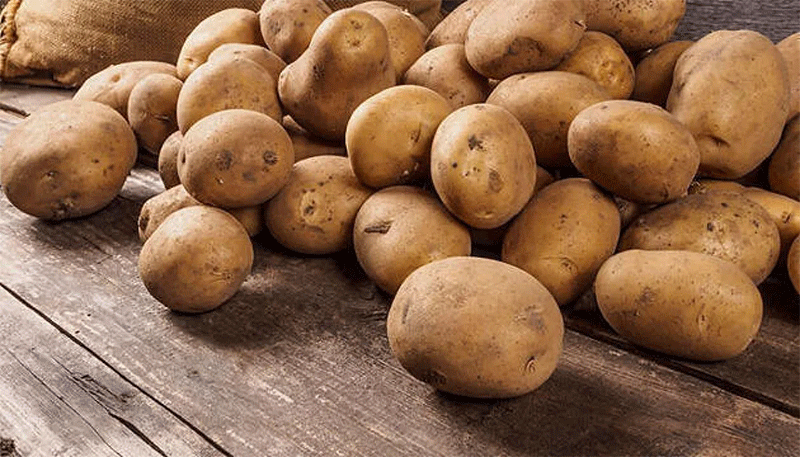
In the heart of Russia’s Ural Mountains, where a short growing season and fungal pressures define agricultural life, farmers are demonstrating how modern science and meticulous management can secure a food supply. Despite losing 15% of their crop to phytophthora (late blight) in the summer of 2024, agronomists in Sverdlovsk Oblast are now poised to harvest a projected 270,000 tons of potatoes. This turnaround story is not one of luck, but of the strategic adoption of resilient seed varieties, industrial-scale harvesting technology, and scientifically-controlled storage—a blueprint for potato-producing regions worldwide facing similar climatic and disease challenges.
The Scale of Operations: Industrial Agriculture in a Challenging Climate
The scale of potato farming in Sverdlovsk is a testament to its agricultural importance. With over 11,000 hectares dedicated to the crop, the region is a significant producer. The operation is highly mechanized, with a single combine harvester capable of collecting up to 180 tons of tubers per day, and KAMAZ trucks hauling 20-ton loads from the fields. This industrial efficiency is crucial for maximizing the limited window of optimal weather in the Ural climate.
The Ever-Present Threat: Phytophthora and the 2024 Fightback
The article highlights the most significant risk to potato yields: phytophthora. This fungal-like pathogen, Phytophthora infestans, is a global menace, causing billions in losses annually. The mention of a 15% yield loss in 2024 is a stark reminder of its virulence. However, the 2024 season showcases a successful containment strategy. The key, as stated by farm manager Vitaly Samorodov, was early detection and the development of a strong skin set (“Кожура у нас встала”). A strong periderm (skin) is a tuber’s first line of defense against rot during storage. This is achieved through careful water management and allowing vines to fully mature before harvest.
The Foundation of Success: Climate-Adapted and Disease-Resistant Varieties
The core of Sverdlovsk’s strategy is its investment in advanced seed science. The varieties mentioned—’Lux’, ‘Terra’, ‘Alyaska’, and ‘Shah’—are specifically bred for the region’s conditions. The ‘Terra’ variety is particularly noteworthy, described as being able to “independently fight fungal diseases” and resistant to drought and cold. This implies strong genetic resistance to phytophthora, a trait that drastically reduces the need for fungicide applications.
The success of these varieties isn’t limited to the Urals. The report of yields reaching 45 tons per hectare in the Astrakhan and Rostov regions demonstrates their adaptability and high-yield potential across diverse Russian climates. This is a powerful example of how strategic seed breeding can create resilient and productive crops, a goal of agricultural scientists worldwide.
The Final Frontier: Mastering the Art of Storage
The harvest is only half the battle. The article provides an excellent overview of the critical post-harvest protocol:
- Drying (3-4 days): Rapidly removing field moisture to prevent microbial growth.
- Curing or “Healing Period” (2 weeks): Holding tubers at warmer temperatures (12-15°C) with high humidity to allow suberin (a protective layer) to form over wounds and cuts.
- Long-Term Storage (at 4.5°C): Gradually lowering the temperature to near-freezing to induce dormancy and prevent sprouting, enabling storage for up to 10 months.
This precise control, managing thousands of tons in warehouses, is what bridges the gap between a successful harvest and year-round supply.
A Model of Integrated, Science-Driven Production
The Sverdlovsk story is a powerful case study in modern agriculture. It shows that success is not defined by avoiding challenges, but by systematically addressing them through:
- Genetic Innovation: Deploying disease-resistant, climate-adapted varieties.
- Precision Management: Implementing timely agronomic practices to combat disease and ensure quality.
- Technological Scale: Utilizing large-scale mechanization for efficiency.
- Post-Harvest Science: Treating storage as a science-critical phase to minimize losses.
For farmers and agronomists globally, the takeaway is clear: building resilience requires an integrated approach that leverages the best of breeding, field management, and logistics. The Ural farmers are proving that even in a demanding environment, a bountiful and secure harvest is an achievable goal.
