Russia remains one of the top potato-producing countries globally, with annual output of 13–14 million tons of potatoes and open-field vegetables, according to recent estimates. However, the country’s capacity to store these crops post-harvest lags far behind, with only 8–9 million tons able to be stored at any given time.
This storage gap represents a serious logistical and economic bottleneck for Russian farmers and the broader food supply chain. As Alexey Krasilnikov, Executive Director of the Potato and Vegetable Market Participants Union, explains, “Not all produce is stored long-term, and the lack of capacity results in significant seasonal market imbalances and post-harvest losses.”
High Costs and Foreign Equipment Dependency
The crux of the issue lies in the costly nature of modern storage facility construction and upgrades, which require specialized climate control systems, refrigeration units, and ventilation infrastructure. Compounding the challenge is Russia’s heavy dependence on foreign equipment suppliers—a reliance that has been increasingly difficult to maintain due to geopolitical tensions, trade restrictions, and disrupted logistics.
Krasilnikov emphasized, “Modernization and new storage construction require significant investments, as most equipment comes from foreign manufacturers. Recent developments have made access to such equipment more difficult, increasing costs and complicating logistics.”
According to industry estimates, building a high-tech vegetable storage facility can cost anywhere from 150 to 250 million rubles (USD $1.5–2.5 million) depending on capacity and automation levels. While some state support is available, it often falls short of meeting the sector’s rapidly growing needs.
Soviet-Era Legacy and Regional Disparities
Many of Russia’s existing storage facilities date back to the Soviet era and lack the capacity to support extended shelf life for fresh produce. These facilities often suffer from poor insulation, inadequate temperature control, and inefficient loading and handling systems—resulting in product losses of up to 25% during storage.
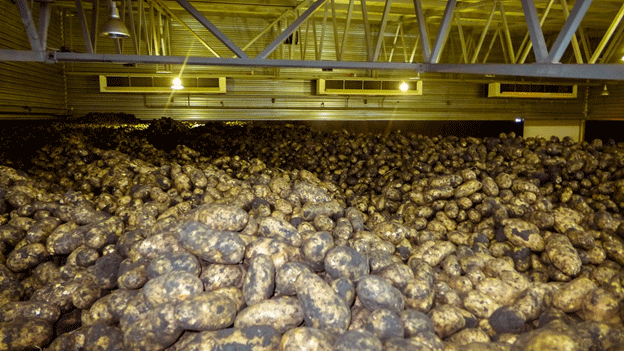
Nonetheless, pockets of innovation exist. Krasilnikov noted that in the Moscow region, some advanced farms now manage to store potatoes from one harvest to the next, thanks to high-tech facilities equipped with humidity and temperature sensors, automatic ventilation, and gas composition regulation. These solutions allow farmers to extend storage life by 6–8 months or more, ensuring a consistent supply of domestic produce and reducing the need for imports.
Government Support and Strategic Priorities
The Russian Ministry of Agriculture has recognized the urgency of these issues and continues to offer annual subsidies and co-financing for storage infrastructure projects. These programs support both the renovation of outdated facilities and the construction of new ones, but industry experts say that a more aggressive and targeted national strategy is required to close the gap.
Krasilnikov advocates for a two-pronged approach:
- Upgrade aging infrastructure, particularly in key potato-producing regions like Krasnodar, Samara, and Novgorod.
- Invest in scalable, modular cold storage systems that can be locally manufactured and adapted to smaller farms.
Russia’s potato and vegetable storage crisis is a structural issue with broad implications for food security, farmer livelihoods, and market stability. Bridging the gap between production and post-harvest infrastructure requires bold investment, policy support, and localized innovation.
Advanced storage technology not only preserves crop quality and extends supply—but also empowers Russia to reduce its dependency on seasonal imports, stabilize domestic prices, and increase export competitiveness in regional markets.
Without significant improvements, Russian farmers will continue to face unnecessary losses and miss out on critical revenue opportunities. The time to modernize is now.
