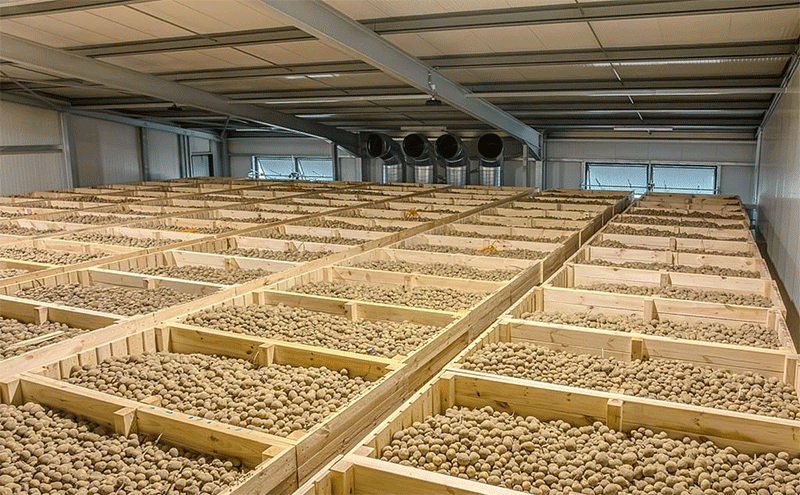
For potato producers, the gamble doesn’t end at harvest. In a year of good yields but low market prices, the ability to store potatoes efficiently and sell them later at a premium has never been more critical. According to the Dutch Arable Farming Association (NAV), storage costs for potatoes delivered in April can account for approximately 17% of the total cost price. A detailed breakdown reveals that sprout inhibitors and facility depreciation (each at 35%) are the largest cost drivers, followed by energy for ventilation at 25%. This cost structure highlights a crucial insight: focusing solely on energy savings misses the bigger picture. The real opportunity lies in an integrated strategy where smart technology optimizes the entire storage environment, leading to cascading savings across all major cost centers.
The cornerstone of this modern approach is smart ventilation, which has evolved far beyond simple on/off cycling. The adoption of high-efficiency, variable-speed EC fans is a game-changer; operating at 80% capacity can reduce power consumption by 50% compared to traditional AC fans, with no compromise on air quality. Furthermore, the integration of advanced climate computers with dynamic energy contracts (like Epex) allows systems to automate ventilation and cooling during periods of low electricity prices. This synergy between agronomy and energy markets represents a significant leap in operational efficiency. Perhaps the most impactful benefit of precise climate control, however, is its effect on tuber dormancy. Maintaining a “tight and stable” temperature can extend the natural dormancy period, potentially reducing sprout inhibitor applications from four to three—a move that alone can slash total storage costs by 9%. This is supported by research from institutions like the Potato Storage Science International, which emphasizes that temperature stability is more critical than a specific set point in minimizing weight loss and metabolic activity.
In the current agricultural landscape, superior storage is no longer a luxury but a fundamental component of business resilience. The shift from manual control to data-driven, automated storage systems is proving that the smartest investments are those that protect the product’s quality and the producer’s margin simultaneously. By leveraging technologies that enable precise temperature and ventilation control, growers can directly attack their largest cost drivers—chemical inputs and energy—while ensuring their potatoes meet the market’s demand for top quality. In an era of volatility, the most reliable profit may very well be the one preserved inside a smart, efficiently managed storage facility.
