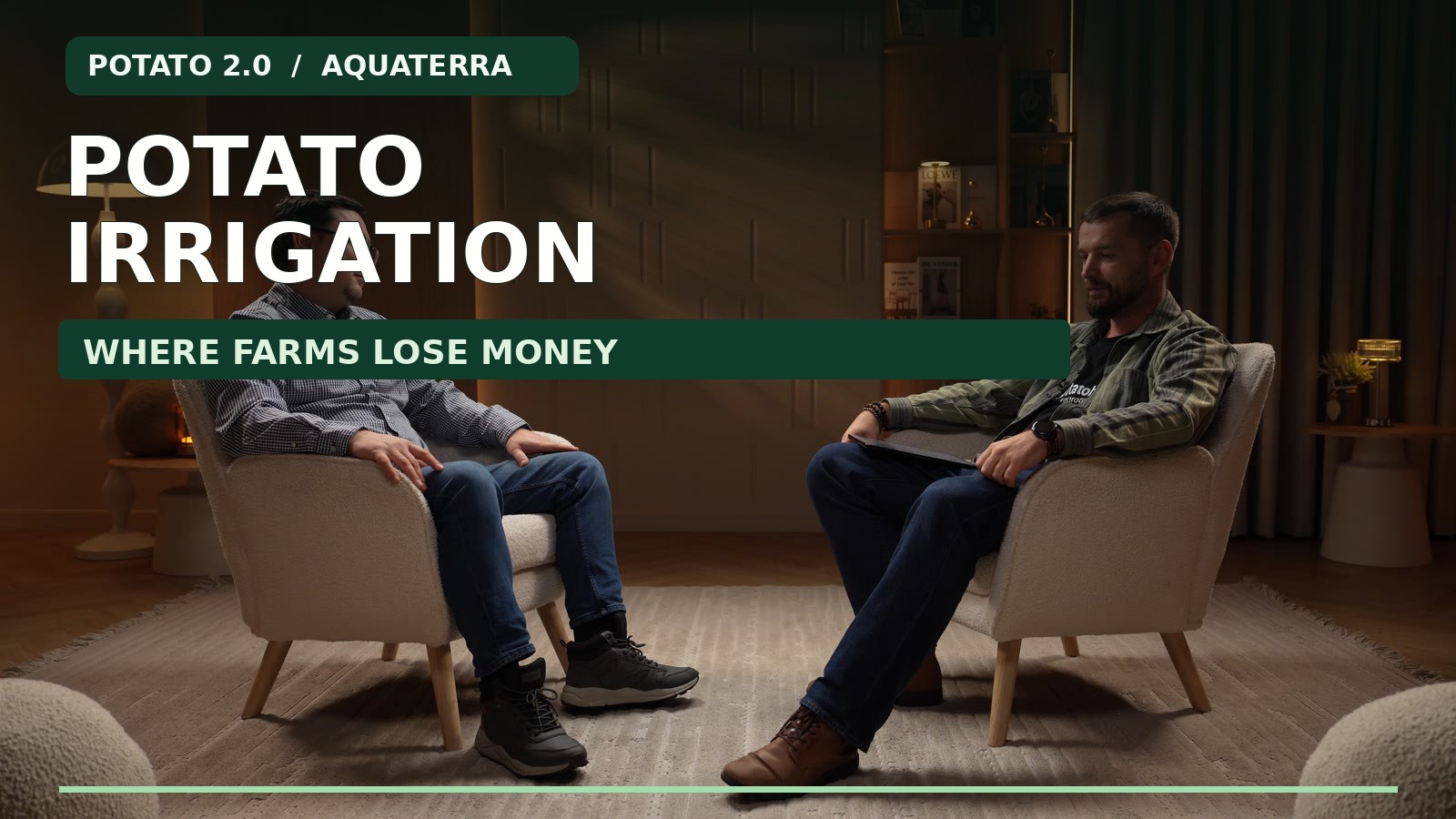
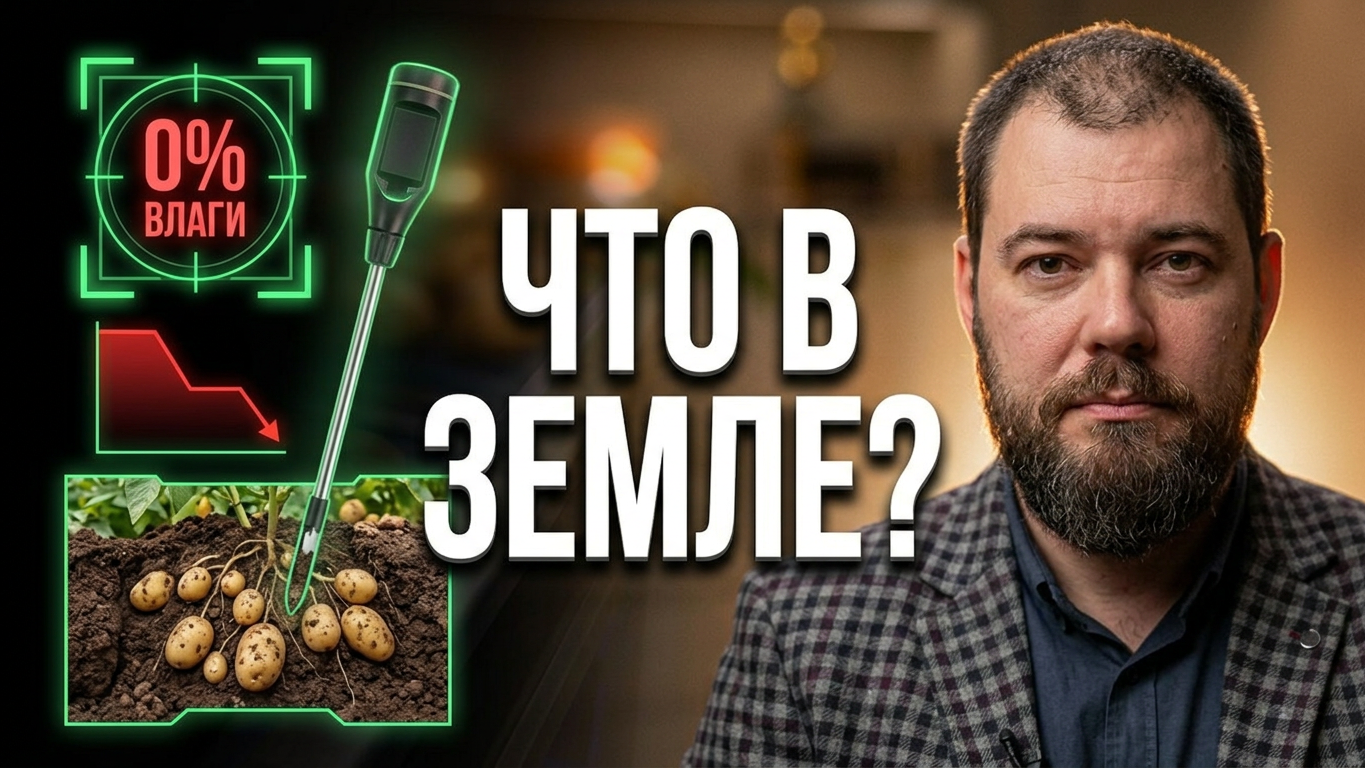
For second-generation potato grower and agricultural video blogger Viktor Retinsky, installing soil-moisture sensors did not immediately make irrigation easier. Instead, it exposed a gap between water reportedly applied by irrigation equipment and the moisture actually reaching the crop. In a POTATO 2.0 interview, host Viktor Kovalev talks with Retinsky and Viktor Loshkaryov, project manager at Kalina Agro, about the practical value—and limitations—of digital irrigation monitoring.
When irrigation reports do not match soil conditions
Retinsky first used weather monitoring and soil sensors while working with the TRIO group in Russia’s Lipetsk region. Later, after establishing his own farm, he purchased a weather station and soil probes. The equipment showed that an irrigation event recorded as complete could still leave the soil profile with insufficient moisture. Catch cups and machine operating times measure application; they cannot by themselves establish how water is distributed through the root zone.
The importance of moisture inside the potato ridge
Water availability matters particularly during tuber development and bulking. Retinsky stresses the need to avoid a dry separation layer between moist soil horizons, which can limit root access to stored water. Equally, excessive irrigation can reduce aeration and result in drainage losses. Appropriate application depths depend on soil texture, crop stage, water-holding capacity and infiltration rate; there is no universally correct number.
What changes between day and night
The guests describe day-night patterns in soil-moisture data. Evapotranspiration is generally stronger in daylight and lower overnight, producing recognizable declines and plateaus on graphs. Yet irrigation schedules should not be optimized solely by time of day: large pivot systems may take several days to complete a cycle, and soil infiltration constrains how rapidly water can be applied without ponding.
How the farm changed application rates
Retinsky says he previously used applications of approximately 12–13 mm. Following the sensor readings, he slowed down his irrigation equipment and in some circumstances increased application depths to approximately 15–20 mm. He reports improved moisture replenishment, fewer repeat passes and fewer machinery problems. More irrigation capacity was also required to cover the farm. These application rates are specific to his circumstances, not general agronomic guidance.
A hidden drip-irrigation failure
An especially revealing problem occurred with disposable drip tape inside potato ridges. Pumps ran and staff reported irrigation, but sensor readings showed continued depletion. Retinsky concluded that settling soil had compressed parts of the drip tape and impaired water delivery. The case illustrates why water application must be checked at the crop root zone, not inferred from pump operation alone.
A 2.5-fold yield difference—with qualifications
Retinsky recounts observing an approximately 2.5-fold yield difference between areas with different irrigation conditions. He explicitly notes that varieties and fields differed, so this was not a controlled experiment and does not prove that installing sensors increased yields by that amount. He also measures performance through marketable potato output, noting that a Gala field formed numerous tubers but a large proportion remained undersized.
Monitoring multiple soil layers
Loshkaryov describes Sentek soil probes configured for monitoring at approximately 10 cm intervals down to a maximum depth of 120 cm, depending on the model. Readings include moisture, temperature and electrical-conductivity-related indicators. These data help reveal water movement and support fertigation management, although conductivity is not a substitute for testing individual nutrient concentrations.
From charts to usable decisions
The discussion covers the IrriMAX Live cloud platform for viewing soil profiles and irrigation responses. Retinsky points out that digital tools need better interfaces and clearer operational summaries: a grower should be able to identify significant anomalies quickly, even from a phone. Local weather stations complement soil sensors with field-level rainfall and temperature observations, including information relevant to frost events.
Can irrigation become fully automatic?
Connecting soil probes to irrigation controllers is technically feasible. In large fields, however, reliable communications, equipment compatibility and correctly calibrated algorithms remain practical challenges. Short-range wireless connections, including Bluetooth, are not a complete answer for every farm. The guests agree that sensor outputs should inform, rather than replace, responsible agronomic judgment.
The essential lesson: learn to interpret the numbers
Digital monitoring can challenge established irrigation practices and create disagreement when measurements conflict with expectations. Data should be checked against soil inspection, probe installation, irrigation-system performance and field variability. As Retinsky emphasizes, growers must learn to analyze the numbers. The return on monitoring depends on better management decisions, not merely on acquiring more devices.
Editorial note: all figures are farm-level observations, not controlled experimental results. Article based on the POTATO 2.0 interview.
Editor's note: Extension guidance broadly supports the guests' approach. Utah State University recommends keeping potato soils at 80–90% of available water (10–20% depletion) from tuber initiation through bulking, as deficits then reduce tuber size and quality. Oregon State University's EM 8911 advises combining weather-station evapotranspiration estimates with root-zone soil-moisture sensors, typically about 20 cm deep in the row. It warns that over-irrigation favours late blight, soft rot and Pythium leak, while even brief water stress lowers tuber grade.
Sources: NSW DPIRD, Sentek moisture probe; Oregon State University Extension, EM 8911; Utah State University Extension