Kenya: Potato Yields Stay Near 10 t/ha, a Quarter of the 40-Tonne Potential

Key takeaways
- 2.19 Mt of potatoes were produced in Kenya in 2024 (FAO)
- 9.7 t/ha was the average Kenyan potato yield in 2024
- 40 t/ha is the yield potential cited by the potato council
- 55-80 shillings per kilo was the ware price range on 23.09
Why it matters
- For farmers
- Compare local prices across towns before selling, and prioritise certified seed, since seed quality is the main lever on a 10 t/ha yield.
- For processors
- Plan for variable raw material and consider contract farming with seed and agronomy support to secure volume and quality.
- For suppliers
- Target the gap between 10 and 40 t/ha with certified seed, balanced fertiliser and advisory packages for smallholders.
- For investors
- Assess storage and aggregation projects: price gaps of up to 25 shillings per kilo between towns signal costly, fragmented logistics.
60-second summary
Kenyan potato growing remains a low-yield smallholder business with large gaps between towns. FAOSTAT shows 2.19 million tonnes harvested in 2024 at roughly 9.7 tonnes per hectare, which implies about 226,000 hectares. The national potato council cites an average of 10 tonnes and a potential of 40 tonnes under good practice, so growers capture only a quarter of what is possible. Its handbook counts more than one million farmers and about 3.3 million people across the chain. Ware prices listed by the council on 23 September 2026 ranged from 55 to 80 shillings per kilo, with Nairobi cheapest and Isiolo dearest. Ethiopia, by comparison, averaged 12.3 tonnes per hectare. Seed suppliers, processors and investors in storage and logistics are the groups that could gain most from higher yields. The caveat is that national and FAOSTAT volumes differ, and the FAOSTAT yield for 2010 looks inconsistent.
Kenya produced 2.19 million tonnes of potatoes in 2024, according to FAOSTAT. The average yield was 9.7 tonnes per hectare. Dividing output by yield gives a harvested area of about 226,000 hectares.
The National Potato Council of Kenya (NPCK) gives a similar yield picture. Its Climate Resilient Potato Production Handbook, published in 2020, puts the average yield at 10 tonnes per hectare. The same handbook estimates the potential at 40 tonnes per hectare per season under recommended practices. Farmers therefore harvest about one quarter of what the crop can deliver.
A smallholder crop
The handbook describes a sector of small farms. It estimates annual output at 1.5 million tonnes on about 161,000 hectares, grown by more than one million farmers. These figures cite a 2014 study and 2019 data from the Kenya National Bureau of Statistics. The handbook also says about 3.3 million people work in the potato chain. They include producers, market agents, transporters, processors and retailers.
Weekdays. Unsubscribe in one click.
The two data sets differ on volume. FAOSTAT shows higher output and a larger area than the national estimate. The FAOSTAT series also records a yield of 22.4 t/ha for 2010. That value is far above national estimates and should be treated with caution.
Prices differ widely between towns
Markets are fragmented. On 23 September 2026, NPCK listed ware potato prices between 55 and 80 shillings per kilo. Nairobi was the cheapest market at 55 to 63 per kilo. Isiolo was the most expensive at 75 to 80 per kilo for the Shangi variety. Nakuru, close to the main growing highlands, quoted 71 per kilo.
Such gaps point to high transport and handling costs. The NPCK handbook lists market agents and transporters among the main actors between farm and consumer.
Regional comparison
FAOSTAT puts the 2024 yield in neighbouring Ethiopia at 12.3 t/ha. Output there reached 4.09 million tonnes. Kenyan yields are therefore lower than those of the largest producer in East Africa.
The NPCK handbook notes that Kenyan potato yields have been declining. It focuses on climate-resilient production practices to reverse that trend.
Why it matters
Potatoes are a staple in Kenya. The handbook cites FAOSTAT data from 2014 putting consumption at about 33 kg per person per year. Yields near 10 t/ha keep supply volatile and costs high. Raising yields toward the 40-tonne potential would need clean seed, better storage and more efficient trade. Seed firms, input suppliers and processors all have a stake in closing that gap.
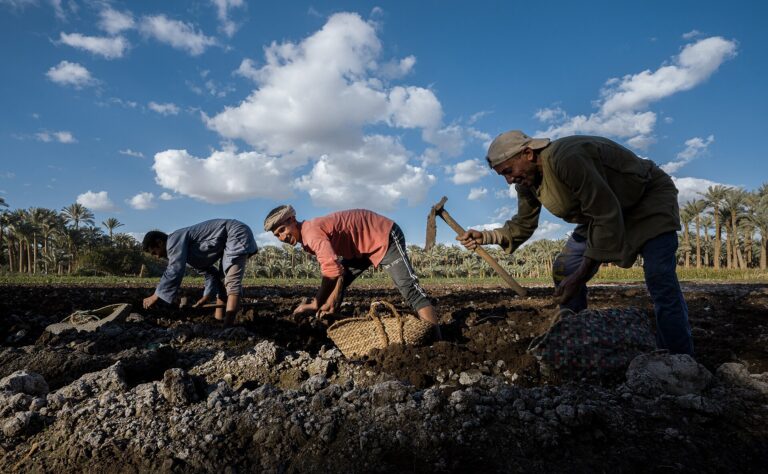
Photo: A potato farm in Kenya (illustrative). Cmwaura / Wikimedia Commons, CC BY-SA 4.0
Global Potato Brief
Top five stories, prices, disease alerts and events. Weekday mornings, no advertising.
Sources
- Our World in Data, potato production (FAOSTAT data, accessed 25.09.2026) — https://ourworldindata.org/grapher/potato-production
- Our World in Data, potato yields (FAOSTAT data, accessed 25.09.2026) — https://ourworldindata.org/grapher/potato-yields
- National Potato Council of Kenya, Climate Resilient Potato Production Handbook (2020) — https://npck.org/wp-content/uploads/2021/11/CLIMATE-RESILIENT-POTATO-PRODUCTION-HANDBOOK2810202001.pdf
- National Potato Council of Kenya, market prices 23.09.2026 — https://npck.org/
Linked in this material
- Country
- Kenya
- Companies
- National Potato Council of Kenya
- Technologies
- certified seed; climate-resilient practices