Global: Potatoes Emit 0.46 kg CO2e per kg, Frozen Fries 0.95–1.21 kg in Life-Cycle Studies
Life-cycle studies put fresh potatoes among the lowest-carbon staple foods. Processing, freezing and frying raise the footprint, and cooking at home can outweigh the farm.
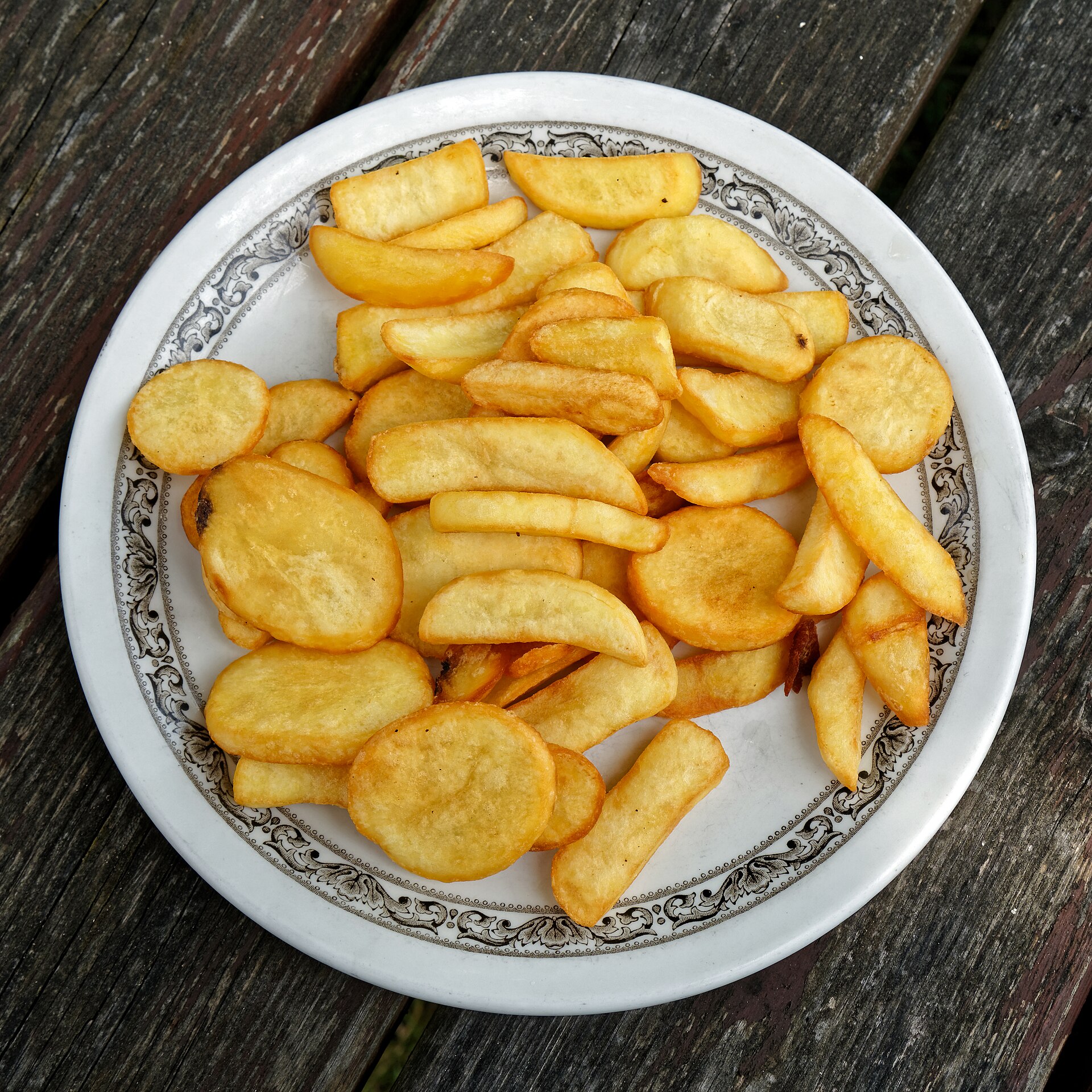
Fresh potatoes have one of the smallest carbon footprints among staple foods. The largest global database of food life-cycle studies, by Joseph Poore and Thomas Nemecek and published by Our World in Data, puts potatoes at 0.46 kg of CO2-equivalent (CO2e) per kg. This compares with 1.57 kg for wheat and rye, 1.70 kg for maize, 1.32 kg for cassava and 4.45 kg for rice.
In the same data, the supply chain breakdown shows that the farm stage gives about 0.19 kg, or roughly 42% of the total. Transport adds about 0.09 kg, food losses another 0.09 kg, packaging 0.04 kg and retail 0.04 kg.
What processing adds
A 2011 study by Blonk Environmental Consultants, from farm to shop, found 0.22 kg CO2e per kg for table potatoes and 0.95 kg for frozen chips (fries). For table potatoes, growing the crop gave about 76% of emissions. Fertiliser production gave 15%, nitrous oxide from fertilised soil 16% and electricity for cold storage 20%. For frozen fries, the picture was reversed: processing gave about 75% and the field only 26%. Natural gas in the factory gave 30%, electricity for freezing 14%, vegetable oil 13% and shop cooling 11%.
Weekdays. Unsubscribe in one click.
A US study from farm to plate, published in 2021 in Science of the Total Environment by Ranjan Parajuli, Marty Matlock and Greg Thoma, counted everything up to the moment the food is eaten. It found 0.97 kg CO2e per kg for fresh potatoes, 0.85 kg for crisps, 1.21 kg for frozen fries and 0.65 kg for dehydrated flakes.
The kitchen matters
For frozen fries in that study, the farm stage gave 18% of the total, while the consumer stage gave 38%, according to a summary by Washington State University. Vegetable oil alone gave 18% of life-cycle emissions. Baking fries in an oven instead of deep frying cut the total by 19%.
Why it matters
Buyers and retailers increasingly ask suppliers for product carbon data. The studies show that the potato itself is a low-carbon crop, and most of the extra footprint of fries comes from energy, oil and cooking.
For growers, fertiliser and cold storage are the main levers. For processors, gas and freezing energy matter most. Results differ between studies because they use different system limits, from farm-to-shop to farm-to-plate, so figures should be compared with care.
Photo: A plate of chips (French fries) (illustrative). Acabashi / Wikimedia Commons, CC BY-SA 4.0