Bolivia: Potato Harvest Reaches 1.38 Million Tonnes but Yields Stay Near 6.5 t/ha
Bolivia grew 1.38 million tonnes of potatoes in 2024, almost double the 2000 level. Yields remain near 6.5 t/ha, far below Peru and Argentina.
Bolivia produced 1.38 million tonnes of potatoes in 2024, according to FAOSTAT data published by Our World in Data. That is 18% more than the 1.17 million tonnes of 2023. Over 24 years, output nearly doubled from 0.72 million tonnes in 2000.
Yield tells a different story. The national average was 6.5 t/ha in 2024 and 5.8 t/ha in 2000, according to FAOSTAT. In 2023 it fell to 5.6 t/ha. Growth came mainly from a larger planted area, not from better productivity.
Where the crop grows
The research centre CIPCA gives a detailed picture of the 2020–2021 season. Bolivia produced 1,272,649 tonnes on 191,321 hectares. The average yield was 6.65 t/ha. These production figures match the FAOSTAT data for 2021.
Weekdays. Unsubscribe in one click.
Two departments dominate: Cochabamba with 30.3% of output and La Paz with 27.3%. Together they supply 57.6% of the national crop. Productivity differs sharply by region. Santa Cruz reached 9.93 t/ha and Cochabamba 9.85 t/ha in that season. The high Altiplano remains the weakest area. The centre reports crop losses above 60% there in the 2021–2022 and 2022–2023 seasons, caused by adverse weather.
Demand and imports
Potatoes are a staple. CIPCA cites consumption of 108 kg per person per year in 2023, based on IBCE data. National demand is about 1.3 million tonnes. The director of the national potato programme at INIAF gives a range of 90–100 kg per person. He also says the country has 33 registered and certified varieties.
Frozen pre-cooked potatoes are imported for about US$30 million per year, according to the same source. National chicken restaurant chains buy them directly from Argentina, Peru and Canada.
Why it matters
A yield of 6.5 t/ha is far below neighbouring countries. FAOSTAT shows 19.5 t/ha in Peru and 35.8 t/ha in Argentina for 2024. In volume, the 2024 harvest roughly matched the estimated demand of 1.3 million tonnes. In quality and processing, the country still depends on imports.
The weather risk in the Altiplano is structural. Losses above 60% in two consecutive seasons show how exposed highland farms are. Better seed, irrigation and storage are the main levers for growers. The market for frozen potato products is a separate opportunity for processors.
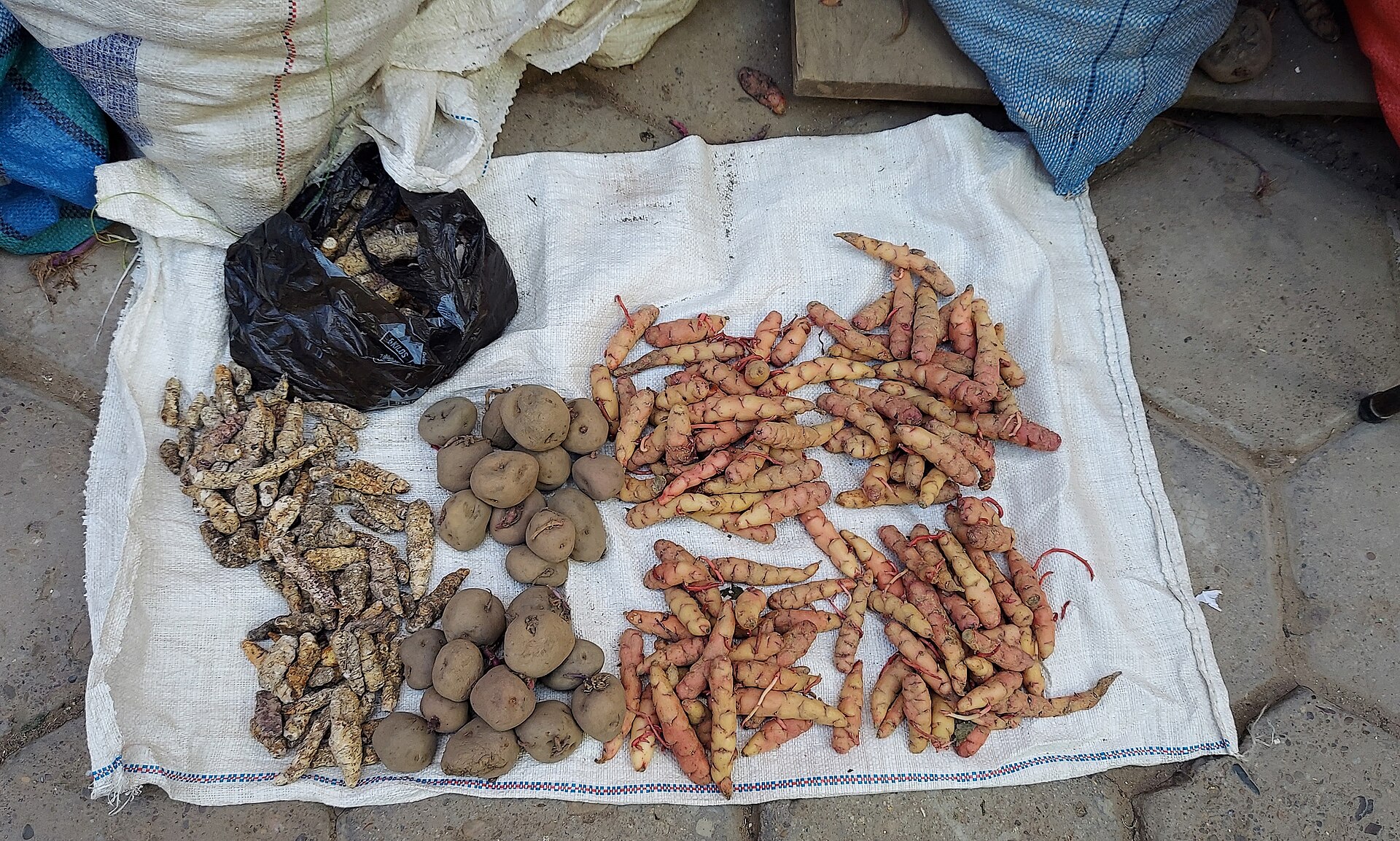
Photo: Potatoes for sale in Copacabana, Bolivia (illustrative). P. Hughes / Wikimedia Commons, CC BY 4.0