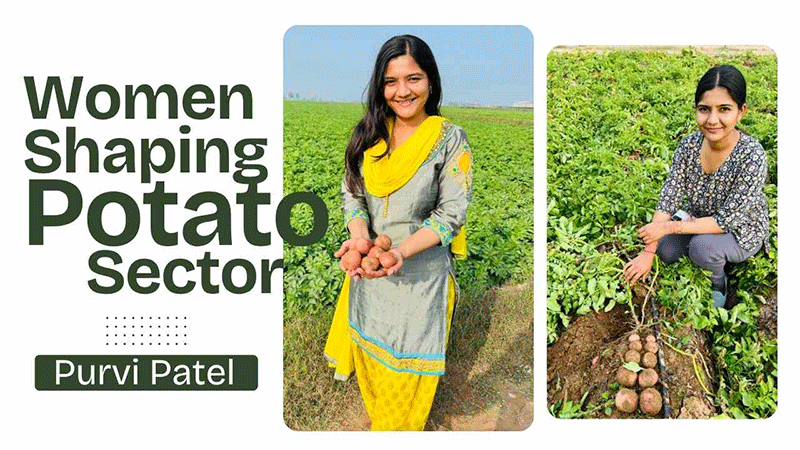
The escalating cost of chemical inputs and rising consumer demand for residue-free produce are pushing potato growers to seek sustainable alternatives. This profile of Ms. Purvi Patel, a plant pathologist who transitioned from academia to the field, offers a data-driven case study on implementing successful biological disease management. Discover how a science-first, farmer-centric approach is delivering measurable results against some of the most persistent soil-borne pathogens.
Ms. Purvi Patel, an M.Sc. in Agriculture (Plant Pathology) and recipient of 11 Gold Medals from Anand Agricultural University, represents a new wave of agricultural expertise. Instead of confining her knowledge to laboratories, she operates from her family’s potato fields in Dolpurkampa, Gujarat, and as a Senior Scientist at Huntin Organics. Her core mission is to translate complex plant pathology into practical, field-ready protocols. She focuses on developing biological systems to manage devastating soil-borne diseases like Common Scab (Streptomyces spp.), Black Scurf and Stem Canker (Rhizoctonia solani), and Bacterial Wilt (Ralstonia solanacearum). Her guiding principle is that “a healthy soil is the best doctor a crop can have,” and her methods explicitly avoid the use of chemical fungicides in soil.
The results from her field trials and farmer adoption are significant. Growers implementing her protocols report a 60-80% reduction in soil-borne disease incidence, alongside observable improvements in root health, tuber quality, and soil organic matter. This aligns with a global shift; the global biocontrol market is projected to grow at a CAGR of over 14%, reaching $11.2 billion by 2030, driven by resistance issues and regulatory pressure. Patel’s work validates this trend at the farm level, demonstrating that microbial soil rejuvenation and organic amendments can create a suppressive soil environment. Crucially, her success is amplified by her empathetic extension work, turning farmers—especially women—into active co-researchers, which ensures high adoption rates and long-term protocol refinement.
The case of Purvi Patel provides a compelling blueprint for the future of integrated pest management in potato cultivation. It proves that effective disease control does not have to come at the expense of soil health or environmental safety. For agronomists and farmers, the key takeaways are clear: a deep understanding of soil microbiology, combined with a commitment to knowledge transfer and farmer collaboration, can yield a resilient and profitable production system. As chemical resistance grows and market demands evolve, this model of biologically-focused, scientifically-grounded, and empathetically-delivered agriculture is not just an alternative—it is a necessity for long-term viability.
