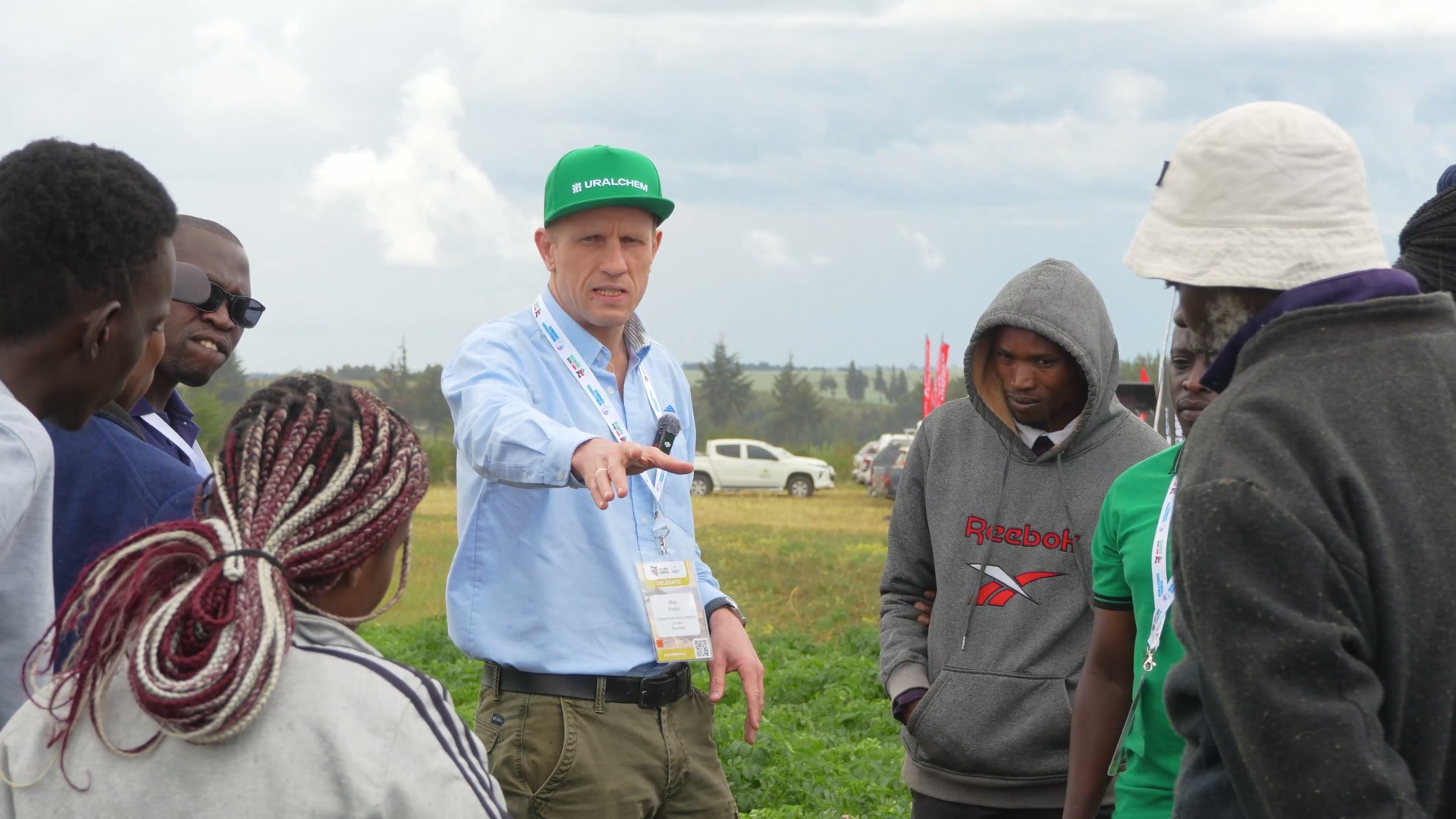
How much of the applied nutrients will stay in the root zone after heavy rain, and how can growers tell whether potassium is making a difference? We discussed these questions in Kenya with Maxim Poltoradnev, the URALCHEM Group representative in Africa. The interview was recorded for the International Potato Tour. URALCHEM is the tour’s crop nutrition partner.
Watch the full interview
What farmers can see on a demonstration plot
Of the countries covered by the company’s farmer education programme, Kenya had the most extensive work, Poltoradnev says. The programme involved research organisations and farmers. Personal contacts, phone calls and radio all help reach people in rural areas. He singles out demonstration plots as a way to compare crop nutrition programmes in the field and get direct feedback from growers.
Demonstration plots were also part of the 2026 World Potato Congress Farmers Field Day in Kenya. The organisers set up plots to show different varieties, crop nutrition programmes and crop management practices. WPC 2026 Farmers Field Day programme
Weekdays. Unsubscribe in one click.
Potassium and the limits of judging nutrition by the canopy
Poltoradnev notes that the canopy and leaf colour respond quickly to nitrogen. Growers can often see the effect of nitrogen application during a field inspection. Potassium helps move nutrients through the plant and supports it under drought or waterlogging. Its effect on crop quality takes longer to see. When comparing nutrition programmes, growers can record yield, marketable grade and tuber quality alongside their canopy observations.
During the two rainy seasons of 2016, on-farm trials in Kenya’s central and eastern highlands found that potassium limited yield on some sites. The researchers recommended testing soil to determine potassium needs. It is worth checking each field, even when neighbouring farms grow potatoes under similar conditions. Study by Mugo and colleagues, International Potato Center
How rainfall changes the risk of nitrogen losses
Heavy rain can carry nitrate nitrogen below the root zone. For conditions with substantial water movement through the soil, Poltoradnev estimated that losses could reach 50–60%. His estimate applies to the conditions he describes. The interview does not include field trial data that would quantify losses on a particular farm. In hot weather, he points to a different risk with urea. When granules remain on the soil surface, some nitrogen can be lost to the air as ammonia. University of Minnesota Extension on urea
Research outside Kenya also shows the effect of the water regime. In a two-year study of irrigated potatoes in Minnesota, researchers measured nitrate leaching on a loamy sand. Reducing irrigation reduced drainage below the root zone and lowered nitrate losses under the conditions of the trial. Bohman, Rosen and Mulla, Journal of Environmental Quality
Growers can use soil tests to assess potassium needs and review the response at harvest by looking at the tubers. The choice of nitrogen source and timing depends on moisture, soil properties and when the crop can take up nutrients.