
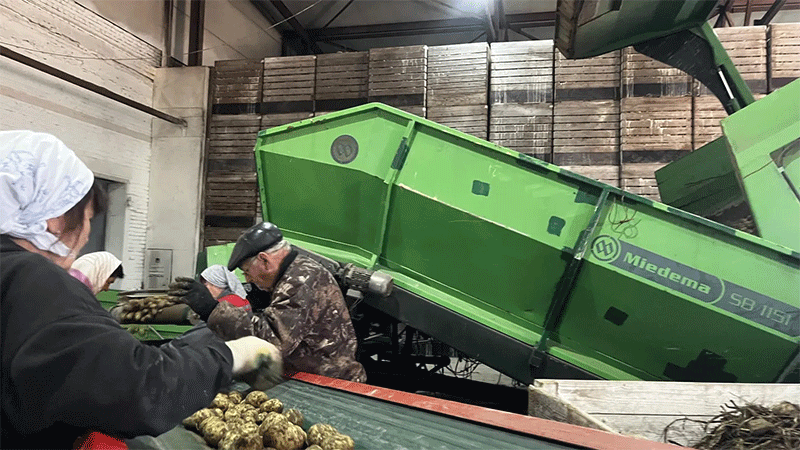
In the village of Leka near Shatura, agricultural producers summed up the harvest of the new seed potato variety “Madeleine.” According to assistant agronomist Yana Patsyuk, the variety performed well even under difficult weather conditions. Vegetation was challenging due to rain, but yields proved high — around 38 tonnes per hectare. The variety was planted on 15 hectares of fields, and approximately 560 tonnes of selected harvest were placed in storage at a specialised warehouse. The variety originates from Dutch breeding, but the enterprise produces all of its seed material independently in its own laboratory using the microclonal propagation method.
Laboratory technician Alexandra Ryabina explained that under sterile conditions the material is placed in test tubes on a nutrient medium and cut into cuttings, after which the seedlings are adapted in peat and transferred to greenhouses. There, mini-tubers free of disease mature and are sent to open ground the following year. The scientific approach and modern technologies help Shatura’s agricultural producers obtain high-quality seeds and a stable harvest, demonstrating how local laboratories can support the adaptation and multiplication of foreign-bred varieties under Russian growing conditions.
