
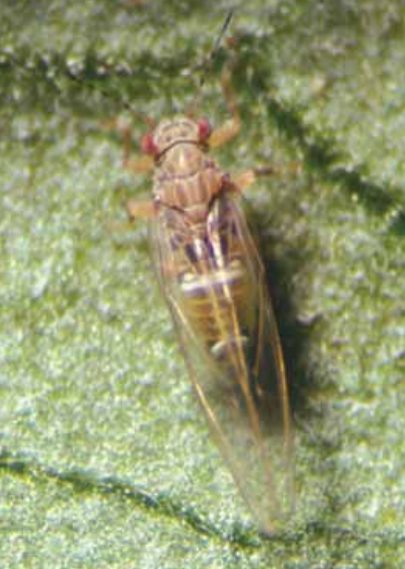
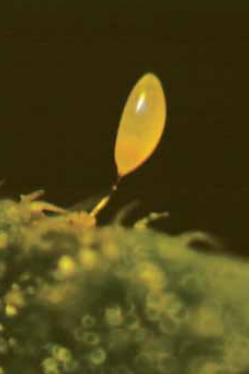
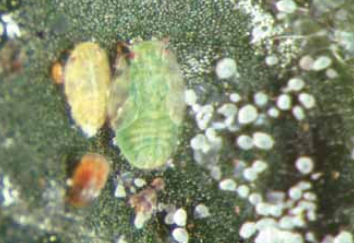
Life stages: eggs, nymphs, adults.
Feeding by adults does not cause significant damage to potato plants. However, the nymphs inject a toxin that causes “psyllid yellows.”
❚ Adults. Adults are about 2 mm long and resemble small cicadas. Their colour goes through gradual changes from light yellow to pale green when they first emerge, brown or green 2 or 3 days later, until they become grey or black with white markings when they are 5 days old. They jump rapidly when disturbed.
❚ Eggs. The eggs are very small, football-shaped, yellow to orange and borne singly on very fine stalks.
❚ Nymphs. Nymphs are flattened and scale-like, with a fringe of short spines. Younger nymphs are pale brown, turning green as they get older. Nymphs are usually found on lower leaves and move readily when disturbed. They secrete a white substance resembling granulated sugar or salt that collects on leaves beneath the feeding insects.
leaf margins.
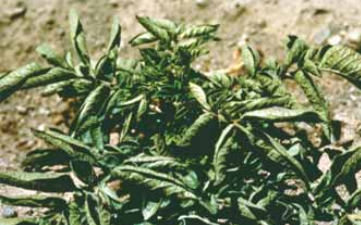
rosettes and the leaves roll upwards. Affected
plants turn yellow; the leaflets of red varieties
turn reddish or purple. Aerial tubers may form.