

Potatoes can suffer from heat stress when temperatures rise. Heat stress severity depends on 1) how hot it gets, 2) the rate of temperature increase, 3) duration of extreme temperatures, and 4) water status of the crop and soil. Temperatures, at least 10°F above normal, that spike suddenly and last a long time under drought conditions, are the worst-case scenario.
Time to Acclimate. If your potatoes have never experienced temperatures higher than 80°F, a sudden jump to 95°F will often result in heat stress. But if the rise to 95°F is gradual, giving the plants time to acclimate, they may not show any signs of stress. This is true for people too. It’s much better to ease into heat exposure.
In fact, Occupational Safety and Health Administration reports that nearly 3 out of 4 fatalities from heat illness happen during the first week of work.
Potatoes, and other plants, acclimate to gradually rising temperatures via biochemical changes such as increasing production of antioxidants, osmoprotectants, heat-shock proteins, and through morphological (structural) or physiological (functional) modifications. These changes help the plants tolerate high temperatures, or they help them avoid or dissipate heat.
Coping Mechanisms
Heat-shock proteins, which occur in all living things, stabilize other proteins during high temperatures, so they don’t aggregate into a tangled mess, enabling proteins to resume their normal function when the stress abates.
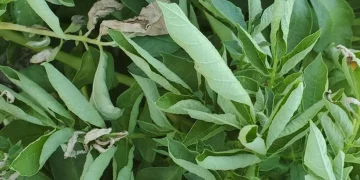
Leaf rolling is a common morphological response to high temperatures. In potatoes, it starts with upward cupping of the leaf margins and progresses to inward rolling of the entire leaf — like a taco. This is a heat-avoidance strategy because it reduces the amount of surface area exposed to the sun’s rays. It can be temporary or permanent depending on the severity and duration of heat stress. The rolled leaves may become thick and leathery if prolonged heat impairs translocation of photosynthates and results in an accumulation of carbohydrates in the leaves.
Leaf senescence. Sometimes plants drop their lower leaves in response to heat stress. It can be an “escape” strategy to conserve resources by decreasing the canopy size.
Small leaves. Potato leaves that develop during high temperatures are usually smaller. This is a common adaptation in hot environments, because small leaves are better able to dissipate heat compared to large leaves.
Transpirational cooling is the process of moving water through the plant, driven by its evaporation from leaves. It is one of the most important heat-mitigating strategies used by plants, because heat is carried off as water changes from a liquid to a vapor state. Think of it as “plant sweat.” This evaporative cooling process can be highly effective when soil moisture is adequate. On a sweltering day, the temperature in a well-hydrated potato field can be up to 10°F cooler than the temperature recorded at the local airport.
Wilting happens when water lost from transpiration exceeds water uptake, and the dehydrated cells lose turgor. It also helps to reduce heat stress because drooping leaves expose less surface area to the sun. Wilting can occur in wet fields on hot days when transpiration rates are high, but the wilting is temporary, and the plants recover during the cooler parts of the day.
Wilting is most serious under drought conditions when plants go into extreme water conservation mode — closing their stomates, limiting water loss, and buying a little more time for drought relief.
Causes of Irreversible Damage
Tipburn (or windburn) can happen when areas of the leaf dehydrate under hot, dry, and windy conditions. It generally occurs at the leaf tips and edges, but it can also be in the middle of the plant. As the damaged areas dry, they become necrotic and brittle.
Tipburn symptoms can resemble late blight, but tipburn is uniformly brown with abrupt margins between healthy and damaged tissues, where late blight lesions often (but not always) have a light green or yellow zone surrounding the lesion. The distribution of symptoms in the field can be an easier way to differentiate these problems; tipburn tends to affect scattered plants in large areas of the field, where late blight is generally clustered in hot spots.
High temps injury of new leaves. When temperatures are extreme, in addition to producing small leaves, the new leaves can be cupped, distorted, or crinkled, and they may be yellow or have a green-yellow mosaic because of chlorophyll degradation. Some call this disorder “heat crinkle.”
It can resemble herbicide injury, and at the cellular level is probably like injury caused by some herbicides. In emerging potatoes, heat crinkle is associated with dark, sandy soils that get really hot on sunny spring days. In larger plants, air temperatures must exceed 104°F to cause the protein damage and degradation that results in these symptoms. Plants on the edges of the field or at the ends of rows are more likely to exhibit heat crinkle because they are more exposed.
Heat sprouts, or heat runners, are a form of the physiological disorder known as “second growth.” High soil temperatures (with or without soil moisture stress) can temporarily pause tuber development. When growth resumes, instead of continuing to expand the tuber, it produces a sprout. The heat sprout will either develop into a leafy above-ground stem, or it will produce another tuber (a chain tuber).
Misshaped tubers. The slowing and resumption of growth that disrupts tuber expansion can alternately result in tubers with bottleneck or dumbbell shapes and knobs.
Pink eye is a physiological disorder associated with high soil temperature and excessive soil moisture that creates an anaerobic condition right around the tuber. The lack of oxygen with heat impairs normal development of epidermal cells, so they are unable to produce normal periderm or skin. Another name for pink eye is “periderm disorder syndrome.” It’s called pink eye because early symptoms usually involve a pink discoloration around the eyes.
Source: American Vegetable Grower. Original article here
Author: Carrie Huffman Wohleb is Associate Professor/Regional Specialist – Potato, Vegetable, and Seed Crops, at Washington State University.
A source: https://www.potatonewstoday.com