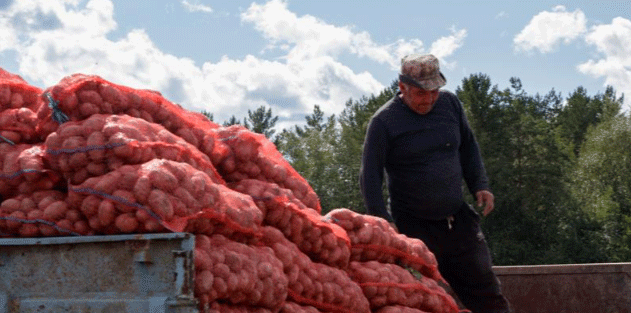
A significant structural shift is underway in Russia’s potato sector, one that holds lessons for agricultural producers globally. According to the Potato Union, the current deficit of fresh, high-quality table potatoes is a direct result of retail networks refusing to enter into forward contracts before the planting season. This practice leaves growers facing immense price uncertainty, making the cultivation of table potatoes financially unattractive. In contrast, the processing industry—producing chips, snacks, and other value-added goods—has successfully secured its supply by contracting potatoes in spring with guaranteed prices, creating a predictable and stable market for farmers.
The Data Behind the Shift: From Fresh to Processed
The financial logic for this shift is undeniable. Without the security of a forward contract, growers bear all the risks of volatile weather, pest pressure, and market gluts. The Potato Union’s statements are corroborated by global data; a study by the International Food Policy Research Institute (IFPRI) found that contract farming can increase a grower’s net income by 20-40% by reducing price uncertainty and ensuring market access. Faced with an uncontracted and often adversarial retail market, Russian growers are rationally allocating more land to technical (processing) varieties. This reallocation is not trivial; processors report that 25% of the entire table potato harvest now ends up in processing plants specifically because it was rejected by retail networks, indicating a massive inefficiency in quality coordination and planning.
Compounding the contracted supply issue are staggering post-harvest losses. The Union cites that a further 30% of the potato crop is lost due to inadequate storage conditions. This aligns with broader global post-harvest challenges; the FAO estimates that in some Eastern European and Central Asian countries, post-harvest losses for root crops and vegetables can exceed 40%. This means that over half of the potential fresh potato supply (25% to processing + 30% lost) never reaches consumers as intended, a catastrophic inefficiency that forward planning and investment in storage infrastructure could mitigate.
The Russian potato deficit is not merely a result of a poor harvest; it is a symptom of a broken value chain. The core issue is a misalignment of risk and reward between producers and retailers. The processing sector’s successful model of forward contracting provides a clear blueprint for stability: it de-risks production for farmers and guarantees supply for buyers. For the fresh potato market to recover, retailers must move towards collaborative, long-term partnerships that include price corridors or formulas. The current system, which externalizes all production risk onto farmers while simultaneously suffering from a 55% effective loss of the potential fresh crop, is unsustainable. For agronomists and farm owners worldwide, this situation underscores that achieving food security and a profitable agricultural sector requires supply chains built on partnership, not just price pressure.
