The International Potato Tour (Международный картофельный тур) continues with a stop at the Babushkin family farm—an operation that treats soil as a living system and seed quality as a promise. In this two-part field report, farmer Andrey Babushkin and his son Nikita walk us through their approach to seed potato production, storage, and digitalization—down to the structure of a soil clod and the spacing of a tuber.
Four–five field rotation with cover crops. The farm builds seed quality from the ground up: potato → cereals with undersown perennials → multi-species cover crops. On sloped fields, mixes like vetch+rye, followed by 12-species cocktails and oilseed radish, protect the topsoil, keep “living roots” in the profile, and work as a natural winter drain. By spring, residue is mostly decomposed, feeding the soil biota the family actively supports with biologicals such as Trichoderma.
Nutrition by removal, not by guesswork. Before potato, the team applies ~20 t/ha of well-decomposed manure and around 700 kg/ha of complex fertilizer, calculated against a target yield of 40–50 t/ha. Nitrogen and magnesium are fine-tuned in-season via leaf diagnostics. The goal: vigorous, stress-resilient plants without sacrificing the seed fraction.
Minimal mechanical impact = stable structure. The Bаbushkins show the contrast between worked and undisturbed horizons: the latter is granular, airy, and smells—quite literally—like a healthy cellar. “The soil should stay alive,” Andrey emphasizes. Too much tillage, rotary harrows, and over-irrigation break aggregates into dust that later sets like concrete. Their rule of thumb: do only as much as needed to preserve structure and porosity.
Dense planting for seed grade. Rows are set to achieve the target mass per square meter: ~5 kg/m² with an average tuber size of 70–80 g. That translates to ~20 cm in-row spacing and, for some varieties and fractions, up to 80,000 tubers/ha. The team pre-sprouts and studies stolon and stem counts to match variety biology with stand density.
2025 season: weather, late blight pressure, and shape. A rainy August forced tight spray intervals against Phytophthora and an early haulm kill to protect tuber health. Result: a high share of seed-grade fractions and, interestingly, rounder tubers in typically long-oval varieties—an effect the farm associates with heat and lower mid-season moisture vs. elongation in wetter years.
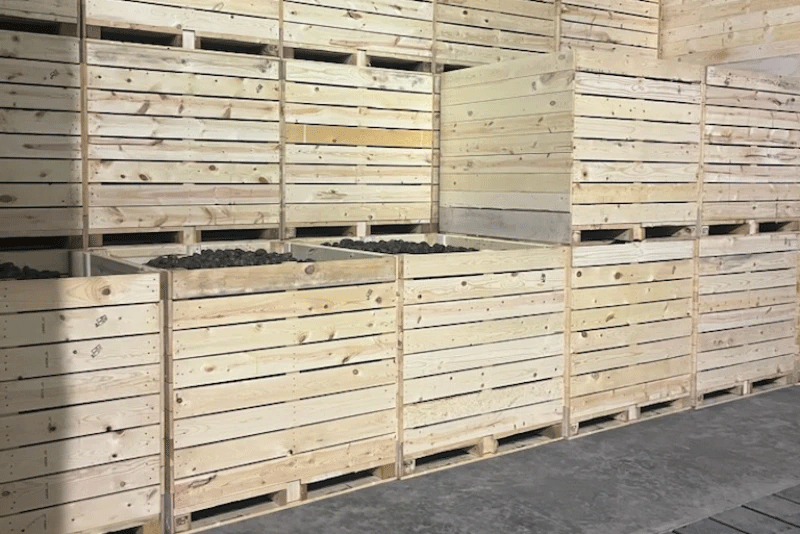
Storage: ventilation strategy over brand loyalty. The farm runs systems from different manufacturers and focuses less on labels and more on algorithms, crop condition, and weather windows. When curing is challenged by cool outside air (+10…+12 °C), they “catch daytime positives” and aren’t shy about auxiliary heat—experience borrowed from onion drying—to safely move from curing to cooling. In steady storage, fans cycle briefly to manage CO₂ and equalize temperatures across piles or containers.
Digitalization with a purpose. Nikita, who joined after a decade in technical work, is pushing video surveillance and dreams of a single, modular platform that unites field operations, storage, and inventory. Off-the-shelf tools exist, he says, but few truly “stitch” the agronomic and logistics layers end-to-end.
Philosophy first. Perhaps the most striking takeaway isn’t a piece of kit but an attitude: “Your land should be able to say: ‘thank you.’” For the Babushkins, that means realistic goals, patient soil building, and seed standards that start long before planting day.
Watch the full field report for digging pits, fraction checks, and day-by-day storage volumes—and share your own experiences with cover crops, curing strategies, and seed density in the comments.