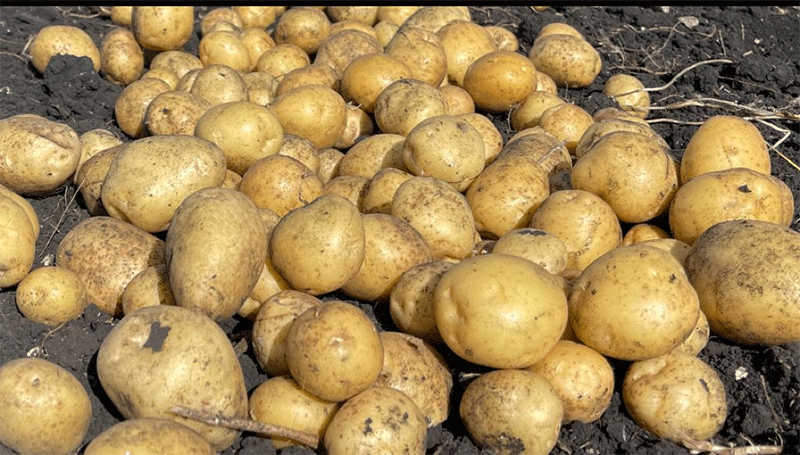
The ‘Riviera’ potato has garnered significant attention as an ultra-early variety, promising a harvest of new potatoes just 45 days after emergence. Such a rapid growth cycle (categorized as very early to first-early class) is a strategic tool for growers. It allows entry into high-value early fresh markets, often commanding premium prices before maincrop varieties flood the market. The reported potential of up to 20 tubers per plant is impressive for a first-early type; however, practical field-scale yields are better evaluated per hectare. Data from European variety trials, such as those in Poland and Germany, show ‘Riviera’ achieving total yields of 35-45 tonnes per hectare under optimal conditions, with a marketable yield proportion highly dependent on timely harvest to avoid oversized or misshapen tubers. Its reported “minimal care” requirement aligns with its short vegetative period, which often allows it to escape peak pressure from late blight (Phytophthora infestans) in many regions, a significant agronomic and cost-saving advantage.
Maximizing the potential of ‘Riviera’ hinges on precise agronomic management tailored to its physiology. The recommendation to use small seed tubers (~70g) is crucial. Larger seed pieces can lead to excessive haulm growth at the expense of tuber initiation and uniform sizing in such a short season—a phenomenon supported by seed physiology research. Pre-sprouting (chitting) is non-negotiable to ensure rapid and even emergence, effectively extending the growing season without extending field time. The variety’s primary commercial limitation is its poor storability, a common trait in early varieties due to thin periderm (skin) and higher metabolic activity. This makes ‘Riviera’ unsuitable for long-term storage; it is a “dig and sell” or “dig and consume” crop. Therefore, its role in a farm system is specific: as a lucrative early-season cash crop, a catch crop in double-cropping systems (e.g., followed by a leafy green or another short-season vegetable), or for growers with direct market access who can move the harvest quickly. Its adaptation to cool springs, provided soil warms sufficiently, makes it a candidate for early tunnels or protected cultivation to achieve the absolute earliest harvest dates.
The ‘Riviera’ potato is not a one-size-fits-all variety but a specialized agricultural instrument. Its extraordinary earliness and decent yield potential offer a clear competitive edge in capturing early market premiums and enhancing land use efficiency through double-cropping. Success requires disciplined agronomy: sourcing quality, correctly sized seed; mandatory chitting; and a well-defined, rapid market channel to offset its poor keeping ability. For commercial growers, its value lies not in total seasonal tonnage but in early-season profitability and system flexibility. It serves as a reminder that in modern agriculture, strategic variety selection is as much about timing and market positioning as it is about sheer yield.
