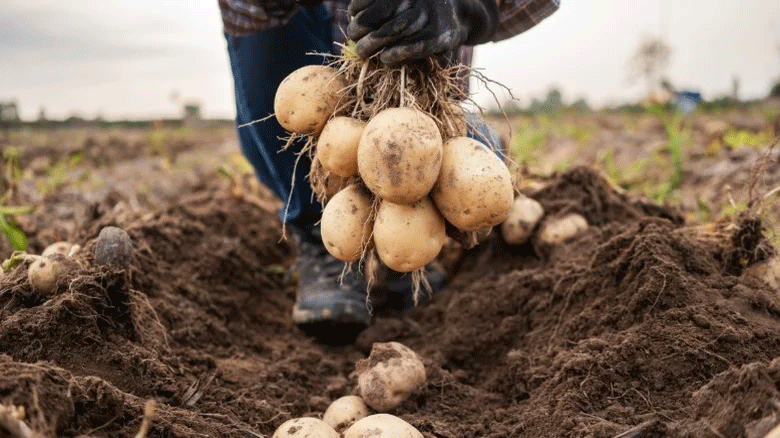
The conventional wisdom of planting potatoes exclusively in spring is being challenged by growers seeking to maximize productivity. As cool-season plants, potatoes (Solanum tuberosum) are inherently suited to autumn’s declining temperatures. The primary agronomic challenge is not the cold itself, but the precise management of the planting window and the plant’s physiological timeline. Success hinges on calculating backwards from the first hard frost date to ensure a minimum of 90 to 110 days for full-season varieties, or a more manageable 60-75 days for early-season types, for the tubers to mature properly.
Key Agronomic Considerations for Fall Planting
The cornerstone of fall potato establishment is soil temperature. Research from leading agricultural extensions, such as the University of California’s Division of Agriculture and Natural Resources, emphasizes that tuberization is optimal when soil temperatures are between 60°F and 70°F (15°C-21°C), while germination requires a cooler range of 45°F to 55°F (7°C-13°C). Planting in early fall, when soil temperatures have dropped from summer highs but are still within this range, provides the ideal start. A critical mistake is planting too early, while soil is still warm, which can lead to poor germination and increased susceptibility to diseases like rhizoctonia.
For northern regions where the frost-free window is short, technology and varietal selection are key. The use of row covers or low tunnels can extend the season by providing 4° to 8°F of frost protection, effectively pushing the first killing frost back by several weeks. Furthermore, selecting early-maturing cultivars with a Days to Maturity (DTM) of less than 80 days, such as ‘Red Pontiac’ (60-75 DTM) or ‘Yukon Gold’ (70-90 DTM), is a strategic necessity. These varieties allow for a complete growth cycle within the constrained autumn period, a practice supported by trials from institutions like Cornell University’s College of Agriculture and Life Sciences, which stress the importance of matching crop genetics to seasonal length.
Fall potato cultivation is a viable and strategically sound practice that can enhance farm productivity and diversify harvest schedules. Its success is not a matter of chance but of precise agronomic management. By focusing on soil temperature metrics, employing season-extension technologies, and rigorously selecting appropriate early-maturing varieties, farmers, agronomists, and agricultural engineers can effectively unlock a productive second season. This approach represents a move towards more resilient and intensive cropping systems, turning the traditional calendar into a flexible framework for innovation.
