
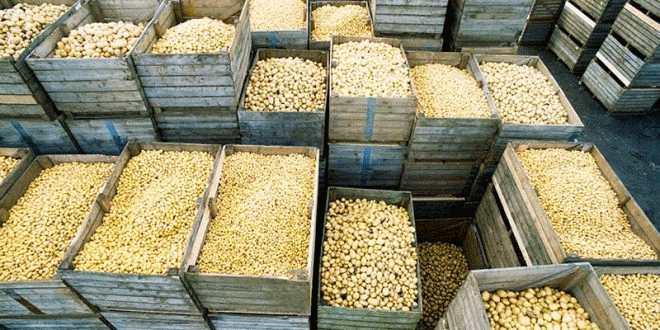
The final truckload from the field marks not an end, but the beginning of agriculture’s most delicate phase: post-harvest storage. For potato managers across Northwestern Europe and similar climates, the work done in the first weeks within the warehouse will largely determine the financial return on the season’s labor. The 2025 harvest presented a common modern challenge: generally healthy yields compromised by weather variability, which accelerated physiological aging and increased vulnerability to bruising. As Frank van der Linden, Senior Agronomist at Omnivent B.V., notes, this elevates the initial drying and wound healing period from a routine step to a critical determinant of long-term storability. Success hinges on a meticulously managed environment where temperature, humidity, and airflow are precisely controlled to guide the crop through its natural processes without inviting disease.
The cornerstone of this phase is effective wound healing (suberization). Experts like van der Linden recommend maintaining a minimum temperature of 10°C, ideally 12–15°C, with 85% relative humidity for 7 to 14 days. This warm, moderately humid environment allows periderm formation, creating a natural barrier against pathogens like Fusarium and Pectobacterium (soft rot). Cooling must follow a gradual taper—0.5°C per day for processing potatoes and 0.3°C per day for seed—to prevent condensation, a precursor to disease. This guidance is supported by broader research; a 2023 study in the Potato Research journal confirmed that rapid cooling before complete suberization can increase disease incidence by over 30%. The irregular 2025 season, with lots lifted from both dry and damp soils, underscores the need for “smart ventilation” based on dew-point differentials, as advocated by technology firms like Tolsma-Grisnich. This data-driven approach, using real-time monitoring to ensure outside air is slightly drier than the crop, prevents re-wetting and manages variable in-store moisture—a key factor in suppressing silver scurf.
Beyond climate control, operational rigor is non-negotiable. Temperature uniformity requires rapid, single-day loading where possible, with ventilation between partial loads. A pre-season mechanical audit—checking seals, fan balance, and airflow with smoke tests—is essential to eliminate cold spots and moisture pockets. Post-healing, raising relative humidity to approximately 95% minimizes shrinkage and weight loss, which can equate to a 2-5% direct financial loss if not managed. Finally, the 2025 advice reinforces that technology does not replace vigilance. Frequent physical inspections in the first fortnight for decay pockets, coupled with rigorous inter-season sanitation of all internal surfaces, are the ultimate defense against pathogens that can devastate a stored crop.
The post-harvest period is a silent, high-stakes marathon where biological management supersedes agronomic skill. The expert consensus for 2025 is clear: a passive, set-and-forget approach to storage is a recipe for loss. Profitability is secured through an active, science-based protocol that prioritizes a dedicated wound-healing phase, employs smart ventilation based on dew-point management, ensures perfect physical storage infrastructure, and maintains relentless sanitation and inspection. By mastering this crucible, potato managers do not just store a crop; they actively preserve and enhance its value, ensuring the year’s efforts are fully realized at the point of sale.
