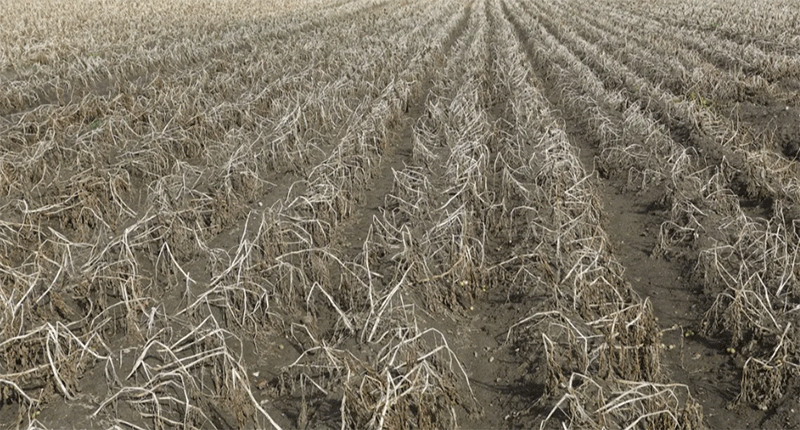
A disturbing sight is unfolding across the farmlands of Niedersachsen, Germany: fields of potatoes left to rot. This is not a result of disease or catastrophic weather, but a calculated economic decision. As explained by Klaus-Dieter Böse and Harald Höper of Landvolk Gifhorn, the market for table potatoes has collapsed under the weight of its own success. A significant expansion in planted area, driven by profitable returns in previous years, has created a massive oversupply. With a static demand and the absence of a major consumption event like a football championship, prices have plummeted to a point where the cost of harvesting, transport, and packing exceeds the potential revenue, making it more economical to abandon the crop.
This situation highlights a critical vulnerability in agricultural commodity markets: the disparity between contracted and open-market production. While starch and processing potatoes are largely sold under forward contracts, a substantial portion of the table stock is grown speculatively. The low barrier to entry—with accessible technology and seed—encouraged a wave of planting, flooding the free market. The Food and Agriculture Organization (FAO) has long warned of such volatility, noting that without effective market intelligence and coordinated planning, commodity booms often lead to busts. Furthermore, the fact that these unharvested potatoes may be diverted to biogas plants for minimal return is a sobering reminder of resource waste. This aligns with EU data on food loss, which identifies market dysfunction as a significant contributor to post-harvest waste long before the product reaches the consumer. The good yields in 2025, a usually positive outcome, have only intensified the crisis, demonstrating that in an oversaturated market, high productivity can be a curse.
The situation in Niedersachsen is a powerful, albeit painful, lesson in agricultural economics. It underscores the inherent risks of speculative production driven by retrospective profitability rather than forward-looking market contracts and demand analysis. For farmers, agronomists, and policymakers, it serves as a critical call to action: enhancing market transparency, promoting stronger contract farming frameworks, and diversifying crop rotations are no longer just best practices but essential strategies for financial and operational resilience. Let the rotting potatoes be a reminder that sustainable profitability is not just about what we can grow, but about knowing where it will go before the seed is even planted.
