
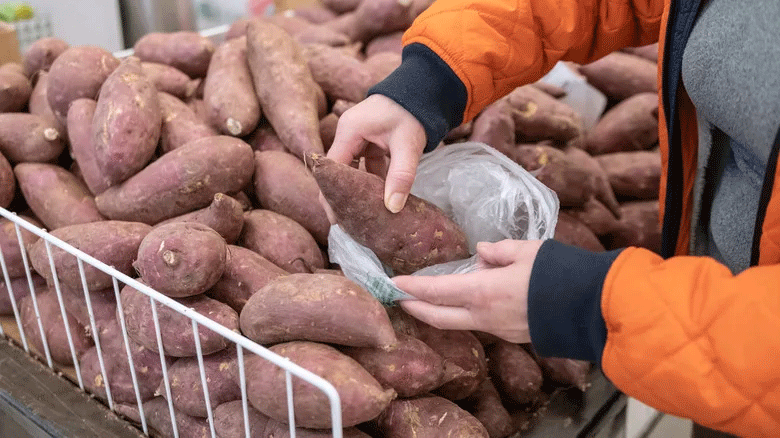
The sweet potato (Ipomoea batatas) presents a fascinating case study in global agricultural production and market dynamics. Despite originating in the Americas, the crop’s production center of gravity has shifted dramatically to China, which now accounts for a staggering majority of the global harvest. However, this dominance does not tell the whole story. Regional powerhouses like the United States have developed highly efficient, self-sufficient production systems that cater to domestic tastes and highlight the crop’s significant value in diversified farming operations. Understanding these patterns is crucial for producers and researchers looking to capitalize on the crop’s resilience and growing consumer demand.
China’s Overwhelming Dominance and Concentrated Production
The scale of China’s sweet potato production is monumental. Accounting for approximately 55% of global output, China produced over 112 billion pounds (roughly 51 million metric tons) in 2023. This aligns with its status as the world’s largest agricultural producer. However, this production is not evenly distributed. A remarkable 80% of China’s domestic supply is concentrated in Liancheng County, which has built its entire economy around the crop. This level of regional specialization suggests highly optimized local supply chains, shared knowledge, and agronomic practices fine-tuned for maximum yield and quality. The crop’s use is diverse, serving not only as a staple food but also as a critical input for industrial applications like alcohol production and animal feed, adding layers of demand that stabilize the market.
The U.S. Model: Self-Sufficiency and Regional Specialization
Contrary to what one might expect, the United States, despite China’s global dominance, maintains a strong and self-reliant sweet potato industry. In 2023, U.S. farms produced over 3 billion pounds (approximately 1.36 million metric tons), a figure that dwarfs its imports of 99 million pounds. This production is not spread evenly across the country but is highly concentrated. North Carolina alone is responsible for over 60% of national production, with California and Mississippi as secondary hubs. This regional specialization mirrors China’s model on a national scale and points to the existence of ideal growing conditions, established infrastructure, and deep expertise in these areas. The success in these states underscores the importance of matching crop varieties to specific agro-ecological zones.
Market Differentiation and Agronomic Implications
The U.S. market further distinguishes itself through varietal diversity, catering to sophisticated consumer palates. The promotion of distinct varieties like the orange-fleshed ‘Jewel’ and ‘Beauregard’ for traditional dishes, and the purple-skinned ‘Murasaki’ for novel applications like fries, indicates a market that values culinary quality and differentiation. This contrasts with a commodity-focused model and presents an opportunity for growers to capture premium prices. From an agronomic perspective, sweet potatoes offer advantages as a hardy, drought-tolerant crop that can thrive in poorer soils where other crops might fail, making them an excellent choice for crop rotation and sustainable farming systems.
A Tale of Two Agricultural Systems
The global sweet potato narrative is one of contrasting yet successful models. China demonstrates the power of massive scale and centralized production for meeting broad domestic and industrial needs. The United States, meanwhile, showcases how targeted regional specialization and a focus on quality and varietal diversity can create a thriving, self-sufficient industry insulated from global supply fluctuations.
For farmers and agricultural professionals, the key takeaway is the crop’s inherent versatility and resilience. Whether aiming for large-scale commodity production or high-value niche markets, the sweet potato represents a significant opportunity. Future success will depend on continued research into higher-yielding, disease-resistant varieties, improved storage technologies, and the development of processing streams that enhance value and reduce waste, ensuring this ancient crop continues to be a modern agricultural success story.
