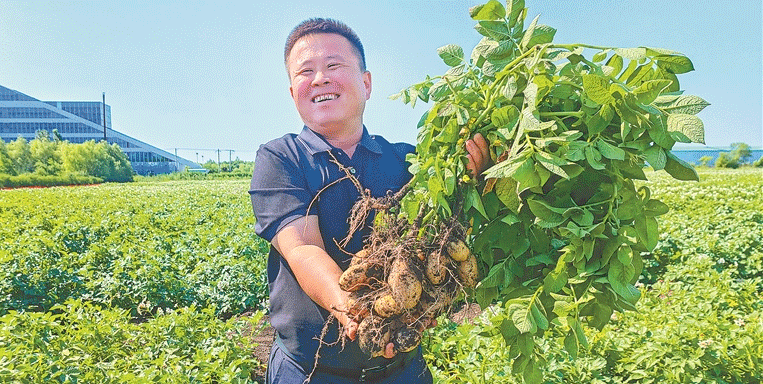
The integration of artificial intelligence (AI), IoT, and satellite monitoring is revolutionizing potato cultivation. In China’s Beidahuang Potato Industry Group, a “sky-land-air integrated” smart farming system has been implemented, using drones, multispectral cameras, and 5G-connected sensors to monitor crop health in real time. This system has led to a 30% reduction in water usage, decreased pesticide application, and a yield increase from 2 to 3.2 tons per acre 2.
Similarly, in the UK, AI-powered early blight detection tools are optimizing fungicide use, cutting costs, and reducing environmental impact 1. These technologies are no longer futuristic concepts—they are current best practices that farmers should adopt to stay competitive.
Genetic Innovation and Seed Development
One of the biggest challenges in potato farming has been seed dependency on imports. However, breakthroughs in seed breeding and biotechnology are changing this. Beidahuang’s “Dongken No. 1” variety, developed in-house, achieves 18% starch content, making it ideal for processing while reducing reliance on foreign seeds 2.
In 2024, space breeding was introduced, where potato seeds were sent into orbit to undergo mutagenesis under microgravity and radiation, resulting in 95% germination rates upon return. This method accelerates the development of disease-resistant, high-yield strains 2.
Market Expansion and Global Demand
The global potato processing market is projected to grow at 5.1% CAGR, reaching $15.7 billion by 2030, driven by rising demand for frozen and ready-to-eat potato products 9. In China, specialized potato snack shops have surged by 45%, with the market expected to hit $28 billion (200 billion RMB) by 2025 4.
Meanwhile, Southeast Asia is emerging as a key export hub, with Vietnam and Malaysia leading in demand for processed potato snacks 8. Companies like Beidahuang are expanding into Thailand and other ASEAN markets, leveraging low-cost production and high local demand 2.
Sustainable Practices and Climate Resilience
With climate change threatening potato yields (optimal growth occurs at 20°C for tuber development), farmers must adopt adaptive strategies:
- Drought-resistant varieties (e.g., “Zhongshu Early 39”, which thrives in diverse climates) 2.
- Precision irrigation (smart systems reduce water waste by 30%) 2.
- Carbon-neutral farming (some European processors are shifting to organic and low-emission methods) 9.
The potato industry is at a pivotal moment, where technology, genetics, and market dynamics are converging to create unprecedented opportunities. Farmers and agribusinesses must embrace:
✔ Smart farming tools (AI, drones, IoT) for efficiency.
✔ High-performance seed varieties to boost yields.
✔ Global market strategies to capitalize on rising demand.
By adopting these innovations, the sector can achieve higher productivity, sustainability, and profitability in the years ahead.
