
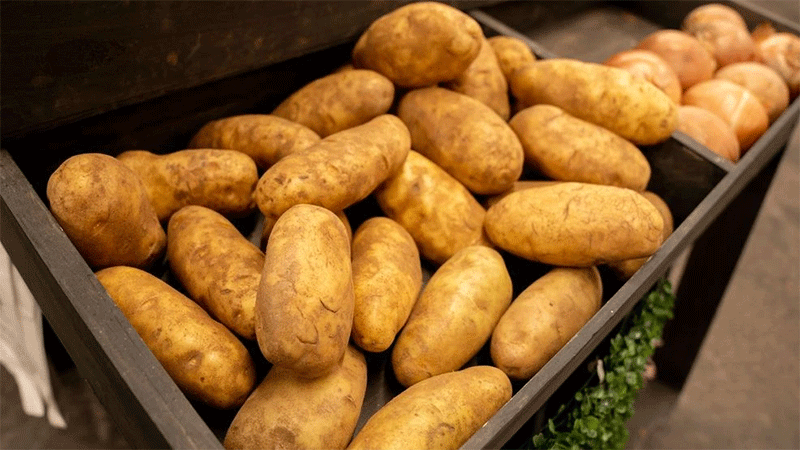
The U.S. potato industry is grappling with a significant setback following the exclusion of fresh potatoes from a recent trade agreement with Japan. Despite Japan being a major importer of American processed potato products—like frozen French fries—its market remains firmly closed to fresh U.S. potatoes. This protectionist stance, maintained under strict phytosanitary grounds, blocks an estimated $150 million in potential annual export value for American farmers. For a state like Idaho, which leads the nation in potato production, this represents a substantial lost revenue opportunity. National Potato Council CEO Kam Quarles labeled the outcome “very disappointing,” highlighting a failure to leverage broader trade negotiations to break through a barrier that has persisted for three decades.
The frustration is compounded by the industry’s strong export record and scientific standing. The U.S. potato industry exports roughly 20% of its total production, demonstrating a proven capacity to meet international standards. Furthermore, the industry has a history of safe exports to other key Asian markets, including South Korea, Taiwan, and Vietnam, without any significant pest or disease incidents. This track record undermines Japan’s stated phytosanitary concerns. The issue has garnered bipartisan political attention, with a group of 10 U.S. senators, including Idaho’s Jim Risch and Mike Crapo, consistently pushing the administration to prioritize this issue. However, as noted in the negotiations, progress remains stalled, leaving U.S. growers at a competitive disadvantage compared to suppliers from countries like Canada and Australia, who have secured access.
Japan’s continued closure to fresh U.S. potatoes is more than a trade irritant; it is a strategic vulnerability for the American potato industry. In an increasingly competitive global market, the inability to access a high-value, nearby market like Japan hinders growth and limits diversification for U.S. growers. The $150 million figure is not just an abstract loss but represents real foregone profits that could be reinvested in farms and rural communities. Moving forward, resolving this issue requires a sustained, science-driven advocacy effort that elevates it beyond periodic trade talks. For farmers, agronomists, and industry leaders, this situation underscores the critical importance of integrating market access as a core component of agricultural strategy, ensuring that political and diplomatic efforts are as robust as production and innovation here at home.
