
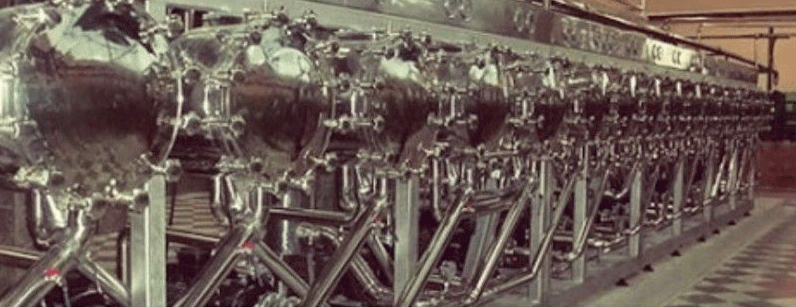
The agricultural processing sector in Russia’s Stavropol Krai is poised for a significant leap forward. A targeted investment project is underway to modernize and drastically expand the production of modified corn starch, a high-value product derived from deep processing. In 2024, the facility in question produced over 8,600 tons of modified starch. Post-modernization, the ambition is to scale annual production capacity to an impressive 35,000 tons, representing a more than fourfold increase.
This expansion is a direct assault on a critical vulnerability in the Russian market: a staggering 70% dependence on imported modified starch. The project is not merely an industrial upgrade but a strategic partnership with the North Caucasus Federal University (SKFU). Together, they are conducting extensive research and development (R&D) to refine production technology, with an initial investment of 6.5 million rubles allocated to this opытно-конструкторская работа (OKR – experimental design work).
The initiative is firmly aligned with national food security goals and is eligible for substantial state support mechanisms. These include a 50% compensation for R&D costs and a rebate of up to 25% on the costs of creating new production infrastructure. Governor Vladimir Vladimirov has explicitly tasked the regional ministry of economic development with providing full technical support, underscoring the project’s political and economic importance. He stated, “Our task is to strengthen the country’s food security. Deep processing and high-tech enterprises in the agro-industrial complex are the key to success.”
The Stavropol starch modernization project is a quintessential example of how modern agriculture transcends the field. It highlights the critical intersection of farming, advanced industrial processing, and national economic strategy. For farmers, it represents a stable, value-added offtake for their grain. For agronomists and scientists, it underscores the need for quality-focused production that meets specific industrial standards. For the nation, it is a strategic move to capture more value from its agricultural output, reduce a significant import dependency, and strengthen its position in the global food ingredient market. Success here could provide a replicable blueprint for other regions and other commodities, truly moving the needle on import substitution and food sovereignty.
