
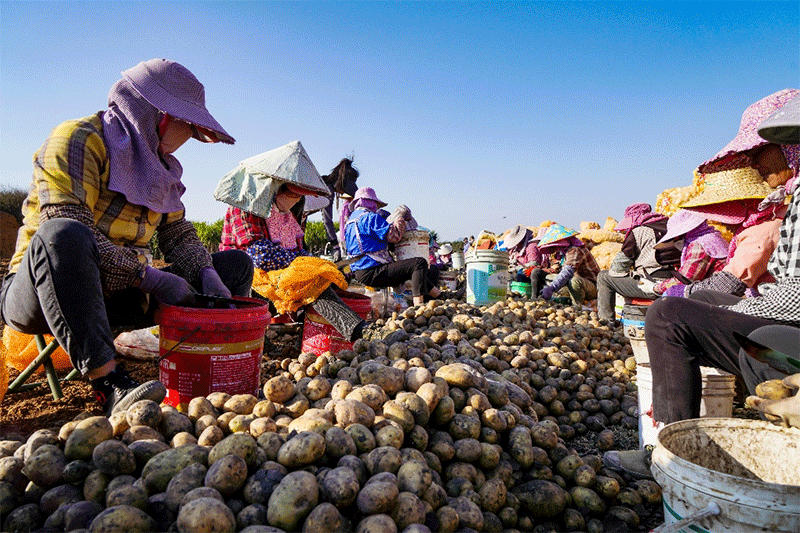
In Xianhu Town, Wuming District of Guangxi, China, the winter potato planting season is showcasing a model of technology-driven, intensive agriculture. The deployment of intelligent agricultural machinery in villages like Naxi and Dengliu is revolutionizing planting operations, significantly improving both the quality and efficiency of sowing. This mechanization push has drastically reduced labor requirements while elevating the level of standardization across the fields. To date, the town’s winter potato cultivation area has surpassed 900 mu (approximately 150 acres), a scale made manageable by this technological adoption. Critically, this expansion has concurrently generated employment, facilitating local job opportunities for over 200 farmers in their home communities—a vital aspect of rural development.
Complementing the hardware investment is a robust soft infrastructure of knowledge transfer. Since the onset of the winter planting season, local agricultural authorities have organized technical experts to conduct over 100 field-based training sessions. These “field head teaching” initiatives have extended technical guidance to more than 2,000 farmer-trainees, ensuring that the benefits of new machinery are coupled with the necessary agronomic expertise. This two-pronged approach aligns with broader trends in global agriculture. According to a 2024 report by the International Food Policy Research Institute (IFPRI), the integration of precision agriculture technologies in developing regions can increase crop productivity by 15-20% while reducing input costs. Furthermore, the focus on winter cropping in Guangxi’s subtropical climate exemplifies a strategic use of the off-season to improve land-use intensity—a practice increasingly recognized as key to meeting rising food demand without expanding agricultural frontiers.
The initiative in Wuming District presents a compelling blueprint for sustainable agricultural intensification in similar climatic zones. It demonstrates that productivity gains are not solely a function of scaled land area but can be achieved through technological precision and improved crop cycle utilization. For farmers and farm owners, the lesson is the tangible value of investing in appropriate machinery to conquer labor bottlenecks and planting windows. For agronomists and policymakers, it underscores the necessity of pairing technology adoption with continuous, localized extension services to ensure proper implementation and maximize return on investment. Ultimately, this model of “smart” winter cropping strengthens regional food systems, bolsters rural economies by creating in-situ employment, and optimizes resource use—a win-win scenario for both productivity and community welfare.
