
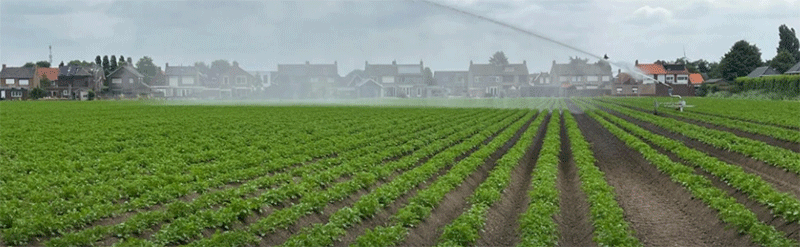
The 2025 growing season in the Netherlands has been defined by a dramatic north-south precipitation gradient, offering a clear illustration of rainfall’s fundamental role in crop production. Data collected from AgroExact weather stations across the “Gewastour” network, from March 1st to October 1st, quantified this divide. Northern provinces like Groningen and Friesland received abundant rainfall, with totals ranging from 370 mm to a high of 448 mm in Uithuizermeeden. In stark contrast, southern regions such as Zeeland and North Brabant experienced significantly drier conditions, with precipitation as low as 217 mm in IJzendijke. This created a staggering disparity of 231 mm between the wettest and driest monitored fields—a difference equivalent to a full season’s rainfall in some arid agricultural regions. This pattern aligns with broader European observations; a 2024 study by the Joint Research Centre (JRC) on climate variability highlighted an increasing frequency of such intra-seasonal and regional precipitation contrasts, challenging farmers’ ability to plan with historical weather norms.
The yield data for both potatoes and onions told a compelling story directly linked to these rainfall maps. Preliminary yield samplings showed that potato fields in the wetter northern clay soils achieved robust yields of 57 to 66 tons per hectare. Meanwhile, yields in the drier south struggled, hovering between 27 and 54 tons per hectare. A similar trend was observed in onions, with northern plots yielding 67 to 86 tons per hectare compared to 50 to 69 tons in the south. This underscores a critical agronomic principle: while irrigation is a powerful tool, it rarely fully compensates for the even distribution and optimal timing of natural rainfall. Irrigation efficiency is often compromised by high evaporation rates and wind, factors less impactful during natural precipitation events. However, the 2025 season also presented a significant economic variable: low potato prices. Many growers admitted to scaling back irrigation efforts, particularly in August, once contractual tonnages were secured, to avoid incurring additional costs on a crop with poor profit margins. This introduces a crucial caveat, suggesting that the observed yield gaps may be a compound result of both water stress and economically motivated under-irrigation.
The 2025 Dutch growing season delivers two powerful lessons for modern agriculture. First, it provides unequivocal evidence that natural rainfall distribution remains an irreplaceable cornerstone for maximizing crop yields, with artificial irrigation serving as a vital but imperfect buffer. Second, and perhaps more critically, it demonstrates that agronomic decisions are inextricably linked to economic realities. The season was not just a story of water scarcity, but of economic scarcity influencing water management. As climate variability increases, the industry must develop more efficient and cost-effective irrigation technologies and strategies. Furthermore, the accumulated soil moisture deficit in the south, while a challenge in 2025, may offer a silver lining by providing a more workable seedbed for the start of the 2026 season, turning a seasonal liability into a potential preparatory advantage.
