
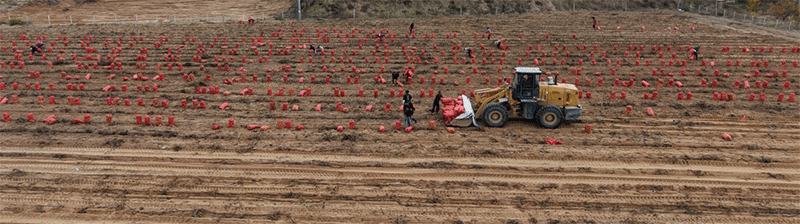
In Changsheng Village, Hongdunjie Town, Jingbian County, Shaanxi Province, the recent potato harvest is a vivid demonstration of modern agricultural efficiency. The key to this success lies not just in agronomy, but in a foundational policy: land transfer. A single operating enterprise manages a consolidated 480-mu (approximately 79 acres) block of land, leased from villagers who collectively transferred over 700 mu. This consolidation enables full mechanization, a critical factor in achieving the reported remarkable yield of 4 tons per mu (equivalent to roughly 60 metric tons per hectare). For context, the global average potato yield is about 21 tons per hectare, with leading European producers averaging 40-50 tons per hectare, according to FAO 2023 data. This puts the Jingbian operation’s productivity at a competitive international level.
The economic model is dual-pronged, creating what local officials term “dual income from one piece of land.” Villagers receive stable rental income for their transferred land parcels and earn wages by working on the consolidated farm. With potatoes selling at 0.8 RMB per jin (approximately $0.11 per pound at current exchange), the scale of the operation ensures significant revenue for the managing enterprise, which is then partially redistributed through wages and rents. The produce enters established supply chains, destined for markets in provinces like Shandong. This model directly addresses the chronic challenges of smallholder farming—fragmentation, low efficiency, and limited market access. A 2024 World Bank report on East Asian agriculture strongly supports such land rental markets as a pathway to scale, noting they can increase productivity by 10-20% while improving rural livelihoods without requiring full land ownership transfer.
The Jingbian potato harvest is a compelling case study in the tangible benefits of land consolidation facilitated by rental markets. For agronomists and farm owners, it reaffirms that high yields are unlocked when scientific techniques are applied at a scale that justifies investment in machinery and management. For policymakers and agricultural engineers, it highlights a viable model for rural development: using land transfer policies to create commercially viable farm units that attract enterprise investment, drive mechanization, and integrate smallholders into profitable value chains as stakeholders rather than sole risk-bearers. This approach offers a blueprint for transforming low-margin, subsistence-oriented plots into high-productivity assets, fueling both local income growth and regional food supply.
