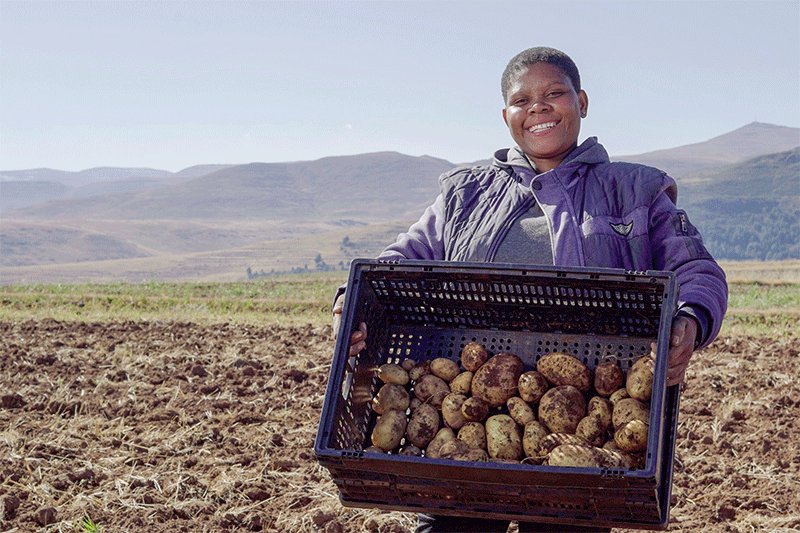
The story of Mabits’oane Diholo, a 53-year-old potato farmer in Lesotho’s Maseru district, encapsulates a quiet revolution sweeping through the nation’s highlands. Once a subsistence grower, she now runs a profitable enterprise, funding her children’s education and mentoring her community. Her catalyst? Strategic intervention through the Food and Agriculture Organization’s (FAO) One Country One Priority Product (OCOP) initiative, which has designated the potato as Lesotho’s engine for agricultural transformation.
Launched in 2021, the global OCOP initiative aims to develop sustainable and inclusive value chains for special agricultural products. For Lesotho, which joined in 2022, the choice was clear. The country’s high-altitude climate provides ideal conditions for potato cultivation, but potential was locked behind barriers of low-quality seeds, limited market access, and subsistence-focused practices. The program directly addressed these pain points by providing 750 farmers, over 60% of whom are women, with certified seeds, fertilizers, and, crucially, a guaranteed market at the Maluti Fresh Produce Market in Maseru.
The results are quantifiable. According to Ntimo Mokitinyane, the FAO OCOP Coordinator in Lesotho, productivity in pilot districts has increased by 20%. This aligns with global data; the International Potato Center (CIP) emphasizes that access to quality seed potato can alone increase yields by 30-50% compared to saved seed. For young farmers like Maleuta Mahao, this support was transformative. Starting with just 25 kg of seeds, her recent harvest exceeded 300 kg—a twelvefold return that demonstrates the power of improved inputs.
Beyond productivity, the most significant shift is economic and behavioral. The initiative has facilitated a crucial pivot from farming for consumption to farming for profit. As explained by Kutoelo Kotelo Molapo of the Lesotho Potato Association, farmers now “talk about contracts, quality standards, and profit margins.” The guaranteed, fair pricing at the Maluti market, with payments twice weekly, has eliminated the exploitation common in roadside sales and injected reliable cash flow into rural economies. This formal market access is a cornerstone of sustainable development, creating what King Letsie III, FAO Goodwill Ambassador for Nutrition, calls “jobs, income, and a decent standard of living.”
The program’s success is deeply tied to its focus on empowering women and youth, who are the primary actors in Lesotho’s agricultural sector. By providing them with data-driven decision-making tools and business training, the project fosters a new entrepreneurial mindset. This is critical for long-term food security; the FAO’s 2023 reports consistently show that empowering women in agriculture significantly increases productivity and reduces hunger at the household and national levels.
The Lesotho potato model offers a powerful blueprint for other nations seeking to revitalize traditional agricultural sectors. Its success hinges on a integrated, value-chain approach that moves beyond mere production support. The key takeaways are:
- Strategic Focus: Selecting a well-suited, high-potential commodity (potato) as a national priority.
- Holistic Intervention: Simultaneously addressing inputs (quality seeds), knowledge (modern techniques), and, most critically, market access.
- Inclusive Empowerment: Intentionally designing programs to uplift the primary cultivators—in this case, women and youth—transforming them into business-oriented entrepreneurs.
This case proves that with the right support systems, traditional crops like potatoes can cease to be mere staples and become powerful catalysts for economic resilience, gender equality, and sustainable rural development.
