
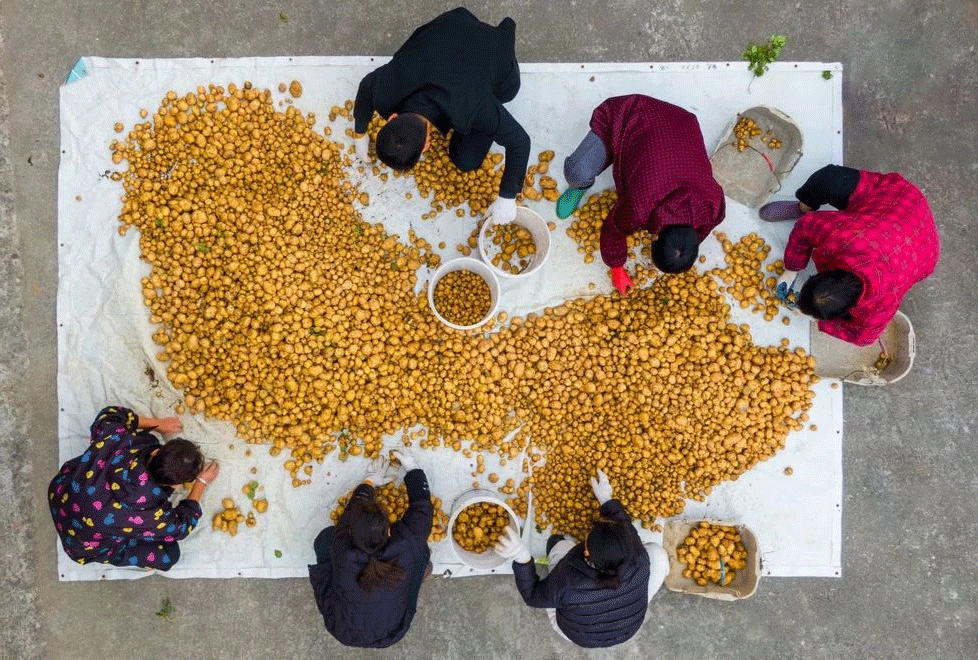
In the Zhoushan archipelago of China’s Zhejiang province, a remarkable agricultural model is redefining rural development. The “Five-Star Potato Commune,” a women-led cooperative (“Jingong Common Prosperity Workshop”), has been recognized as a provincial-level best practice case. This initiative demonstrates that the greatest yield gains may not come from the field alone, but from strategically building value around the crop. Operating on a modest 8.6-hectare (21-acre) ecological planting base, the cooperative has united over 100 households from three villages as “potato partners” under a collective economic model, achieving centralized purchasing and sales with shared profits.
The commune’s success is rooted in a bold departure from commodity farming. In under two years, they sold 60 metric tons (approx. 132,000 lbs) of potatoes, generating gross revenue of ¥450,000 (approx. $62,000 USD) and creating steady employment for more than 20 local women. This financial achievement was driven by a conscious shift from selling a raw product to marketing an experience. The cooperative developed a strong regional brand, “Five-Star Island Potato,” and complemented it with a charismatic brand mascot, “Doudou” (Bean). They mastered direct-to-consumer engagement through serialized short videos and regular live-stream sales, even innovating a local express delivery route to overcome inherent island logistics challenges.
However, the most significant innovation lies in vertical integration and diversification. The commune leveraged its core agricultural product to build a “Production-Sales-Tourism” industrial chain. They established a themed restaurant, “The Taste of Mom,” created children’s educational tourism programs at a “Tea and Bean” camp, and launched an annual “Island Potato Festival.” This “planting + catering + research + festival” model effectively transforms the humble tuber from a staple crop into a cultural and recreational commodity. This approach aligns with global trends in agritourism, where farms diversify income and build customer loyalty by offering immersive experiences. For island and remote communities worldwide, this case proves that geographic isolation can be reframed as a unique selling point for authenticity and eco-friendly branding.
The Five-Star Potato Commune offers a powerful lesson in agricultural economics for the 21st century. Its success is not measured merely in yield per hectare, but in value created per community member. By empowering a specific demographic (women), strategically using digital tools for storytelling and sales, and courageously expanding into experiential tourism, the cooperative built a resilient, circular rural economy. This model provides a scalable template for other farming communities, especially those in peripheral regions, demonstrating that future profitability hinges on innovative business models and community-centric brand building as much as on agronomic science.
