
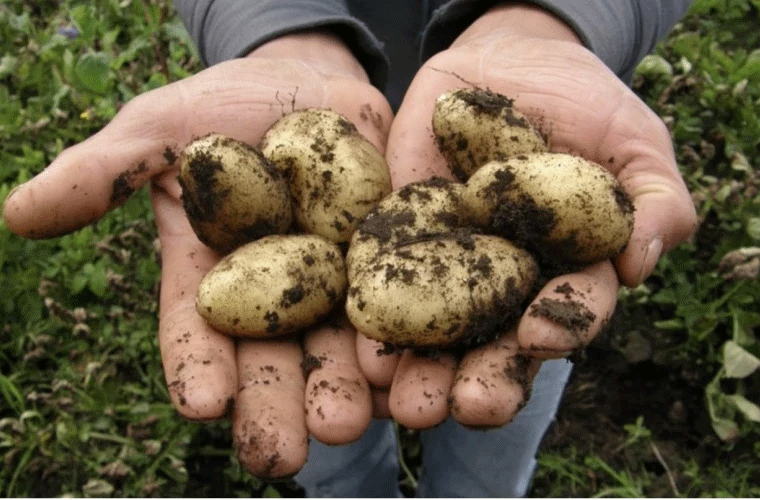
The journey of Vasile Niculîță, a farmer from the Hîncești district of Moldova, encapsulates the profound challenge and potential of scaling organic potato production in a post-Soviet context. After seven years of research and manual experimentation on small plots, Niculîță has developed a functional organic system, yielding approximately 5 tons annually. His initial approach was starkly traditional: daily hand-picking of Colorado potato beetles and manual weeding. This labor intensity, as he notes, is unsustainable for modern, smaller families, highlighting a key bottleneck for organic expansion—the reliance on prohibitively high manual labor inputs that his ancestors could rely upon with larger households. This reality is reflected in the broader Moldovan agricultural landscape, where only 1.4% of farmland (approx. 28,000 ha) is under organic management, with a mere 140 certified producers, according to national data.
Niculîță’s evolution points toward a necessary pathway for viability: the integration of approved biological inputs and mechanization. His breakthrough came from sourcing an imported, certified organic biological insecticide from Ukraine, based on parasitic fungi, to target wireworms, soil pests, and the Colorado potato beetle. This underscores a critical dependency and market gap: a 2024 report by FiBL (Research Institute of Organic Agriculture) identified Eastern Europe as a region with high growth potential for organic agriculture but noted a severe shortage of locally produced, approved bio-inputs, forcing reliance on expensive imports. Niculîță is now addressing the labor bottleneck directly by investing in machinery—a tractor, planter, and harvester—and planning to scale from small plots to a one-hectare dedicated operation next year. This transition from hoe to tractor is emblematic of the shift from subsistence-oriented organic gardening to commercial organic farming, where economic calculation and efficiency become paramount.
Vasile Niculîță’s story is a microcosm of the organic sector’s development challenges in emerging economies. It demonstrates that success hinges on moving beyond nostalgic replication of “grandfather’s methods” to a systems-based approach that combines agronomic innovation (access to effective, certified bio-inputs) with economic pragmatism (mechanization to control labor costs). His reliance on imported biological controls reveals a significant opportunity for local scientific and entrepreneurial development in the bio-input sector. For agronomists and farmers, the key takeaway is that scaling organic production requires a deliberate, two-pronged strategy: first, securing a reliable, cost-effective arsenal of biological pest and disease management tools, often through local innovation or partnership; and second, a calculated investment in appropriate-scale mechanization to replace unsustainable manual labor. His planned expansion to one hectare will be a critical test of whether this integrated model can achieve both agronomic success and economic resilience.
