
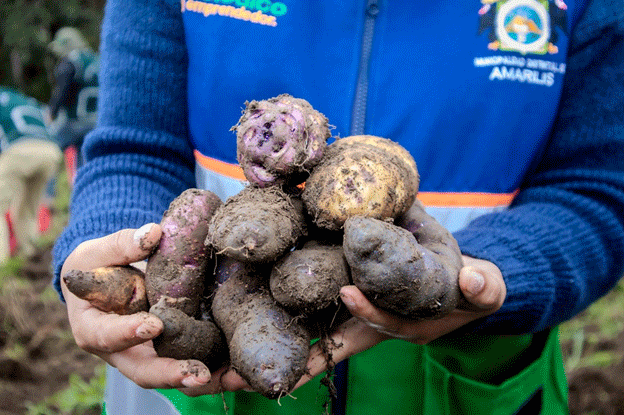
The District Municipality of Amarilis, in collaboration with the Institute for Development and Environment (IDMA) and the Regional Directorate of Agriculture (DRA), has completed a successful harvest of more than 6 metric tons of native organic potatoes in the highland community of Shismay, Peru. This achievement marks an important milestone in the district’s efforts to promote sustainable agriculture, protect biodiversity, and support local livelihoods.
A Win for Local Biodiversity and Food Security
Shismay, located in the central highlands of the Huánuco region, is part of Peru’s rich agricultural heritage zone, home to hundreds of native potato varieties. Peru is the global origin of the potato, and its native landraces—often cultivated at elevations above 3,000 meters—are vital genetic resources for global food security, especially under changing climatic conditions.
According to the International Potato Center (CIP), Peru conserves more than 3,000 varieties of native potatoes, many of which are still cultivated by smallholder farmers in traditional systems. These native varieties are often better adapted to low-input, high-altitude conditions, making them ideal candidates for organic production and climate-resilient farming.
The successful organic harvest in Amarilis reinforces this approach. The project adhered strictly to ecological standards, eliminating the use of chemical fertilizers and pesticides, and promoting natural crop rotations, local seed saving, and community-led soil fertility practices. The native potatoes were cultivated respecting ancestral agroecological cycles, ensuring not only environmental protection but also the preservation of cultural knowledge.
Institutional Support and Community Empowerment
“This is a clear demonstration of how institutional coordination with local farmers can deliver real results,” said Víctor Arévalo, Economic Development Manager for the district. “It’s not just about growing food—it’s about respecting nature, strengthening our identity, and building resilient rural economies.”
The initiative is part of broader efforts in the region to promote territorial branding, agroecological certification, and short supply chains—elements that are increasingly recognized by global institutions like the FAO and UNDP as key strategies for sustainable rural development.
Bringing Healthy, Affordable Food to the People
Beyond the field, the Municipality of Amarilis is ensuring that these high-quality native potatoes reach local consumers. From Friday to Saturday, the potatoes will be available in Green Points across the district, as well as in the Real Plaza shopping center, at “social prices” to ensure equitable access.
This model not only reduces post-harvest losses and shortens supply chains—it also connects consumers with farmers and raises awareness about the value of native, healthy food.
The organic native potato harvest in Amarilis is more than a local success—it’s a replicable model for how communities can blend tradition, science, and sustainability to build resilient food systems. Through cooperative governance, ecological farming, and community marketing, Amarilis is showing that sustainable agriculture can feed people, protect biodiversity, and lift rural economies—all at once.
