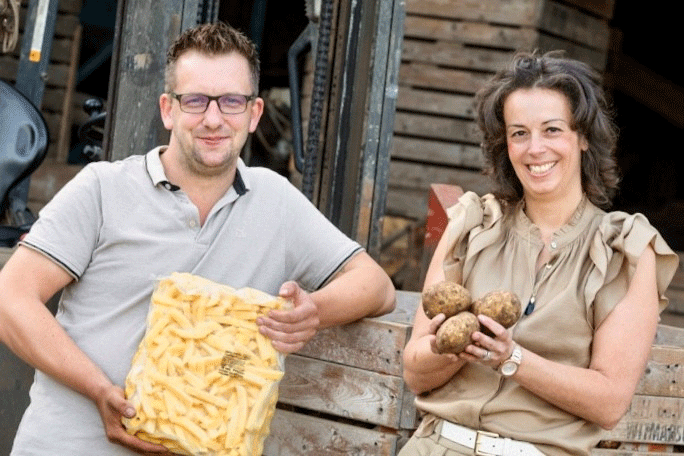
In an agricultural landscape often defined by volatile commodity prices and squeezed margins, a compelling alternative model is gaining traction. Chiel van den Eertwegh, a Limburg farmer, has transitioned from being a mere supplier to becoming a co-owner of Bex BV, a processor specializing in fresh, cold-cut french fries. This strategic move to vertical integration—controlling production from seed to packaged product—allows him to capture significantly more value from his 50-hectare potato operation. By eliminating intermediaries and leveraging a hyper-local supply chain, with fields located just four kilometers from the factory, this model offers a blueprint for farmers seeking to de-commoditize their produce, ensure a guaranteed market, and build a more profitable and resilient business.
The Economics of a Shortened Supply Chain
The primary driver for this integration is economic resilience. Van den Eertwegh explicitly states that producing his own fries delivers “considerably more return” than selling potatoes anonymously on the open market. This is particularly crucial in the context of 2025’s low free-market potato prices. By moving into processing, he captures the value-added margin that would typically go to a separate company. This aligns with broader agricultural economic data. A study on food value chains found that farmers engaged in direct marketing or value-added activities can capture 40-60% of the retail price, compared to 15-25% when selling through conventional wholesale channels.
Furthermore, the four-kilometer distance between field and factory is a strategic advantage beyond mere logistics. It drastically reduces the carbon footprint associated with transport and minimizes tuber damage and quality degradation that can occur during long-haul shipping. This proximity enables a “day-fresh” product claim that is both a marketing strength and an operational reality.
Quality and Market Differentiation Through Agronomic Control
The Bex model is not just about cost-cutting; it’s fundamentally about quality. The company’s focus on the Agria variety, renowned for its full flavor and optimal frying color, is a deliberate choice for a premium product. The “cold-processing” method—where potatoes are peeled and cut without pre-frying—preserves the authentic potato taste, a key differentiator in a market saturated with pre-frozen, par-fried products. This results in a fresh product with an eight-day shelf life, targeted at discerning hospitality clients in the Netherlands, Germany, Belgium, and Austria.
This control over the entire process allows for unparalleled quality assurance. Van den Eertwegh’s deep agronomic knowledge directly informs the processing operation, ensuring that only potatoes meeting specific standards are used. This synergy between grower and processor is difficult for large, industrial competitors to replicate. The planned construction of a new storage facility on the factory grounds represents the next logical step in this full integration, further streamlining the post-harvest workflow and securing raw material quality.
A Viable Model for the Future of Farming
The success of the Van den Eertwegh and Bex partnership offers a powerful case study for the agricultural community. It demonstrates that profitability in the 21st century may depend less on maximizing yield at all costs and more on strategically capturing more of the value chain. This “short chain” model provides a buffer against commodity market fluctuations, creates a unique market position based on quality and provenance, and fosters a more direct connection with the end-consumer.
For farmers, this suggests exploring partnerships or investments in processing as a viable path to financial security. For agronomists and engineers, it highlights the importance of developing varieties and practices specifically for high-value, fresh-market products. Ultimately, this Dutch example proves that by controlling their destiny from “field to fryer,” farmers can build a more sustainable, profitable, and rewarding enterprise.
