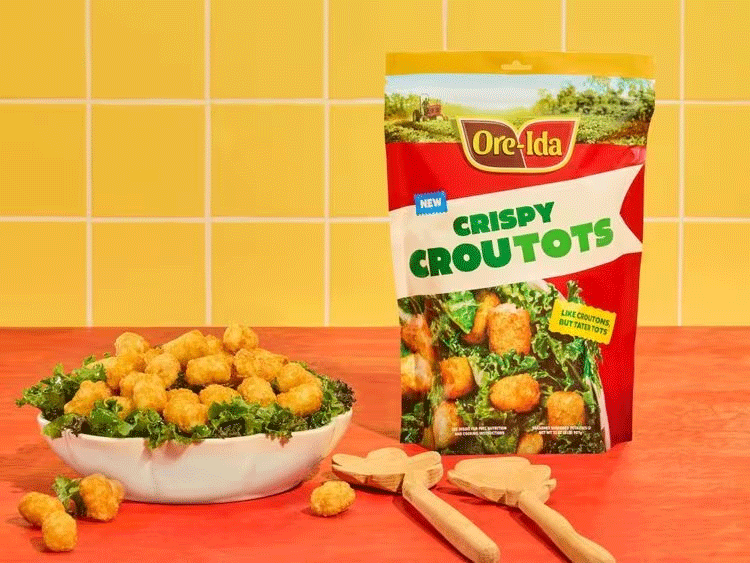
The recent announcement of ORE-IDA’s Crispy CrouTots—a shelf-stable hybrid of Tater Tots and salad croutons—might seem like a simple product line extension. However, for those of us in agriculture, from growers to scientists, it represents a significant evolution in how potato crops are being valorized to meet shifting consumer demands and complex supply chain logistics.
This innovation is not created in a vacuum. It is a direct response to powerful market forces, demonstrating how agricultural producers must adapt to stay relevant.
Harnessing the Power of Social Media and Consumer Trends
As stated by ORE-IDA’s Director of Marketing, the product was inspired by fans swapping Tater Tots for croutons on social media. This highlights a critical shift in the product development pipeline: the consumer is now a co-creator. Agronomists and farm owners should take note; understanding end-use applications is no longer just about yield and grade, but about versatility and “mash-up” potential.
This aligns with the broader trend of “snackification.” According to a 2023 report from Food Insight, over 60% of consumers snack at least twice a day. Products like CrouTots, which blur the lines between a side dish, a salad topping, and a standalone snack, are strategically positioned to capture this all-day eating occasion. For potato growers, this means the market is increasingly demanding potatoes that are not just for fries or fresh tables, but for processed, versatile formats.
The Critical Role of Shelf-Stable Innovation
A key technical specification of the CrouTots is that they are shelf-stable. This is a major point of differentiation from ORE-IDA’s traditional frozen portfolio and a significant development for agricultural engineers and food scientists. Moving a potato product from the frozen to the ambient aisle reduces logistical costs, energy consumption, and expands its potential distribution to venues without freezer capacity (e.g., convenience stores, food service operations).
The global shelf-stable food market is projected to reach USD 70.5 billion by 2028, growing at a CAGR of 4.5% (Grand View Research, 2024). Innovations in dehydration, packaging (like modified atmospheres), and oil/fat technology are making this possible. For the potato industry, advancing shelf-stable processing can reduce post-harvest losses and open up new, less infrastructure-dependent export channels.
E-commerce as the New Product Launchpad
The exclusive initial release through the rapid-delivery platform Gopuff is a masterclass in modern go-to-market strategy. It allows for a controlled, data-rich launch in dense urban markets before a costly national rollout. For farm owners, this underscores the growing importance of understanding the digital path to market. The businesses buying your raw commodities are increasingly reliant on e-commerce data to make planting and production forecasts.
This direct-to-consumer channel test allows ORE-IDA to gauge real-world demand and refine its messaging before approaching traditional retail buyers, de-risking the innovation process for a new agricultural product.
ORE-IDA’s Crispy CrouTots are a microcosm of the modern food industry. They demonstrate that future success in agriculture hinges on a tightly integrated chain that connects social media trend spotting, agile food science and engineering to create shelf-stable products, and strategic e-commerce distribution. For farmers, agronomists, and engineers, the lesson is clear: the value of a potato is no longer determined solely in the field, but also in its potential for transformation, convenience, and direct resonance with the digitally-driven consumer.
