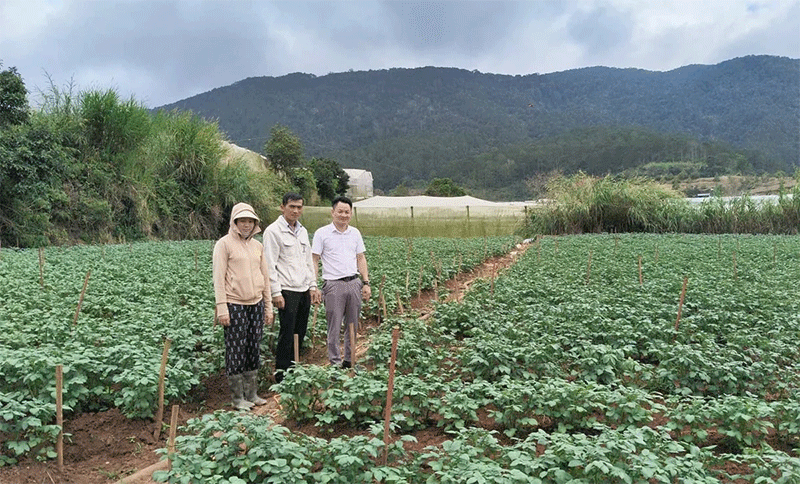
Vietnam’s Central Highlands (Tay Nguyen), the nation’s second-largest potato-producing region, presents a paradox of potential and underperformance. With a cool, stable climate enabling year-round production and average yields of 18-20 tons/ha, the area has historically been constrained by traditional practices, low mechanization, and a critical lack of market linkages. The result was high production costs and low farmer income. To bridge this gap, the Potato, Vegetable and Flower Research Center launched a targeted pilot project: “Building a raw potato production model linked to a product consumption system in several Tay Nguyen provinces.” This initiative moves beyond singular agronomic fixes to implement a holistic, market-driven system.
The project’s core pillars are precision and partnership. First, it enforces varietal standardization, introducing high-performing, dual-purpose (fresh and processing) cultivars like ‘Atlantic’ and ‘TK15.80’, selected for ecological suitability and disease resistance (notably bacterial wilt and viruses). Second, it mandates a unified technical protocol with strict input control and direct agronomist oversight on each of the 34 pilot hectares. The most transformative pillar, however, is the pre-established “bao tiêu” (output contract) with processing companies, guaranteeing a fixed purchase price—11,000 VND/kg in the 2025 season. This off-take agreement de-risks investment for farmers and ensures the produced volume meets industrial quality standards. The 2025 results are telling: despite severe storms and flooding that impacted the region, proactive site selection (higher ground) and emergency early harvests saved the crop. Yields exceeded 20 tons/ha, generating revenue of over 220 million VND/ha and, critically, a net profit above 100 million VND/ha. This profitability is staggering when compared to regional alternatives and to the project’s 2024 profit, which was even higher at over 26 tons/ha, underscoring the model’s resilience.
This success aligns with broader trends in sustainable intensification. A 2023 World Bank report on Agri-food System Modernization in Southeast Asia emphasizes that smallholder competitiveness hinges precisely on such integrated systems—combining quality inputs, knowledge transfer, and market access. The Tay Nguyen model directly addresses the “missing middle” in agricultural value chains. Furthermore, the focus on processing-grade varieties like ‘Atlantic’ taps into a growing domestic and regional demand for frozen fries and chips, a sector where Vietnam is increasingly a key player. The project demonstrates that climate resilience is not just about tolerant varieties, but about agile, informed management and supply chain coordination that can execute strategies like preventive harvesting in response to weather forecasts.
The Tay Nguyen potato model is a seminal case study in how to unlock agricultural potential through systemic intervention. It proves that exceptional profitability is achievable not merely by increasing yield, but by strategically integrating certified planting material, disciplined agronomy, and—most importantly—secured market access into a cohesive package. The impressive net profit of over 100 million VND/ha, even in a climatically challenging year, provides a compelling economic argument for replication. For policymakers and development agencies, the key takeaway is the imperative to support such integrated projects that simultaneously address production, post-harvest, and market constraints. For farmers and cooperatives, it highlights that the path to higher income lies in organization, standardization, and forging direct, reliable links to agribusiness.
