
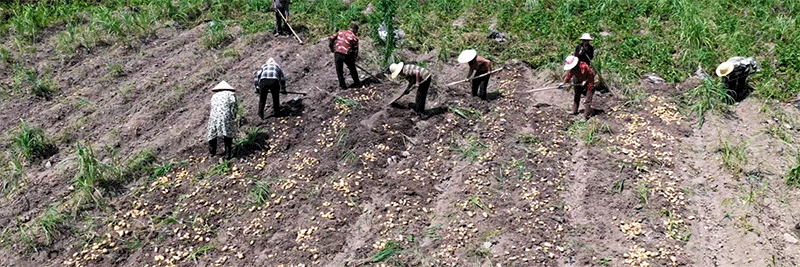
In a groundbreaking shift for agricultural logistics, Xianfeng County in China’s Wuling Mountain region has adopted drone-assisted potato transport, dramatically improving efficiency in challenging terrains. Supported by the China Rural Development Foundation, the Changlin Eco-Agricultural Cooperative deployed four heavy-lift drones to streamline harvesting and transportation—an innovation that could set a precedent for remote farming areas worldwide.
Unprecedented Efficiency Gains
Operating at altitudes above 800 meters, these drones carry 85 kg of potatoes per trip, completing a round in just 30 seconds. In contrast, manual labor requires 30 minutes to transport 25–35 kg over the same rugged terrain. According to drone operator Ran Zuhai, smart route planning and obstacle avoidance enable a daily transport capacity of 15 tons—100 times more efficient than traditional methods.
Globally, drone usage in agriculture is expanding rapidly. The FAO reports that UAVs can reduce labor costs by up to 50% in difficult landscapes, while a 2023 World Bank study highlights a 30% increase in smallholder profits where drones replace manual transport.
Economic Impact on Farmers
Potatoes are a key income source for Xianfeng’s farmers, but mountainous terrain has long hindered productivity. Farmer Luo Hezhong recalls the exhausting old methods: “Carrying loads by hand was slow and painful. Drones have made it effortless.” Yang Guangqiong, another local farmer, emphasizes that this is the first time advanced tech has been applied to potato logistics in the region.
The shift isn’t just about speed—it’s about sustainability and scalability. Yan Hongmei, head of the Changlin Cooperative, notes: “Drones aren’t just moving potatoes; they’re moving farmers toward prosperity.” Similar projects in Peru and Rwanda have shown 20–40% yield improvements post-drone adoption, per 2024 data from the International Potato Center.
A Model for the Future
Xianfeng’s success demonstrates how low-cost automation can overcome geographic barriers, reduce labor burdens, and enhance profitability. As drone technology becomes more accessible, its integration into mountainous and small-scale farming could revolutionize global agri-supply chains.
