
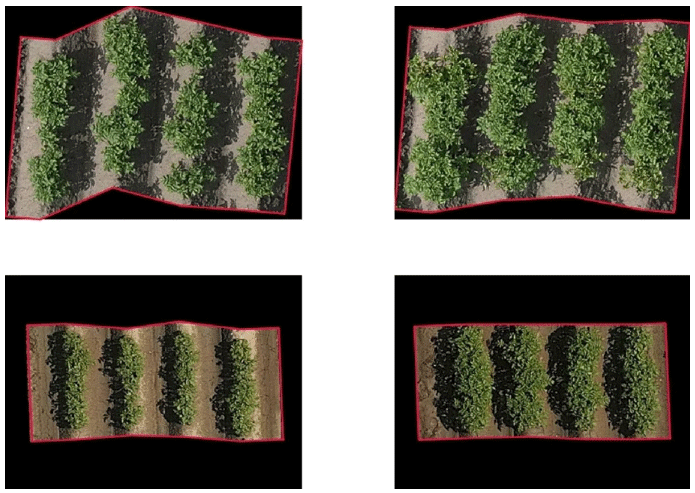
For potato growers and seed producers, achieving uniform and vigorous crop emergence is a cornerstone of profitability. However, predicting the field performance of a seedlot based solely on the physical attributes of the tubers has long been a challenge. A comprehensive multi-year, multi-location study has now provided critical insights, confirming that the vigor of plants grown from genetically identical seed tubers can be systematically different and, for some varieties, predicted through advanced biochemical analysis.
The research, conducted over three years (2019-2021) in test fields across France and the Netherlands, involved six commercial varieties (Challenger, Colomba, Festien, Innovator, Sagitta, and Seresta). Each variety was represented by 30 distinct seedlots of different production origins. The key finding is that vigor, quantified by drone-measured canopy area at 47 Days After Planting (DAP), showed significant correlations across test fields for some varieties but not others. This indicates a strong genotype-by-environment (GxE) interaction, where the expressivity of vigor traits depends on both the genetic makeup and the growing conditions.
The core of the investigation was to determine if biochemical properties of the seed tubers could serve as a reliable proxy for field performance. The answer is nuanced:
- Predictable Varieties: For Festien and, to a lesser extent, Sagitta, vigor was “fairly predictable.” A data-driven model using biochemical data could distinguish between below-average, average, and above-average vigor classes with practical accuracy. This level of predictability is sufficient for high-throughput grading of seedlots.
- Unpredictable Varieties: For the other four varieties (Challenger, Colomba, Innovator, and Seresta), no reliable prediction model could be established. The vigor correlations across fields were inconsistent, suggesting that for these genotypes, factors beyond the measured biochemical constitution—perhaps stochastic biological processes or unmeasured environmental cues—play a dominant role.
Crucially, through variable selection algorithms, the study identified Fourier-Transform Infrared (FTIR) spectroscopy of dry tuber samples as the most powerful and efficient diagnostic tool. FTIR provides a rapid, high-throughput chemical fingerprint, making it an ideal technology for industrial-scale application. This finding is significant as it moves beyond slower, more costly analytical methods.
The research also highlights a major hurdle: environmental influence. The year 2021 presented adverse conditions that drastically reduced predictability and field correlation, particularly in France. This underscores that any predictive model must eventually incorporate readily available environmental data to account for GxE interactions. The path forward lies in integrating biochemical tuber data into physiology-informed growth models calibrated for specific genotypes.
This project successfully confirms the hypothesis that a seed tuber’s biochemical profile contains valuable information about its potential field vigor. However, the applicability of this knowledge is highly variety-specific. For a stable variety like Festien, FTIR spectroscopy presents a breakthrough, offering a fast, scalable method to categorize seedlot quality and effectively replace more laborious germination tests. For other varieties, the quest for predictability continues, pointing to the need for more dynamic vigor measures and models that account for environmental variability. For the seed industry, the immediate implication is the potential for varietal-specific vigor certification using FTIR, enabling growers to make more informed purchasing decisions and optimize field performance. The future of seed testing will likely blend high-throughput biochemical phenotyping with environmental modeling to deliver truly predictive power.
