
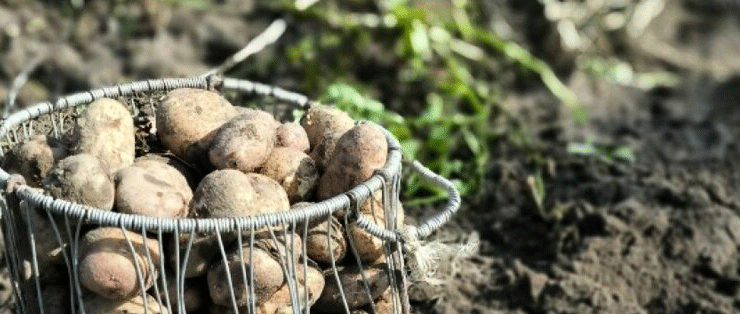
Recent data from Komistat, the statistical office of Russia’s Komi Republic, paints a concerning picture for open-field crop production in 2025, highlighting the acute vulnerability of traditional farming systems to climatic and economic pressures. The potato harvest by early November fell by 46% year-on-year to just 2,400 tons, while the harvest of open-ground vegetables collapsed by 55% to a mere 352 tons from only 16 hectares. Primary cited causes are a contraction in planted area and deteriorating climatic conditions. This aligns with broader trends; the IPCC’s Sixth Assessment Report (2023) notes that high-latitude regions like Komi are experiencing some of the most rapid warming on Earth, leading to increased precipitation variability, thawing permafrost, and a higher frequency of unseasonal frosts and pests, all of which disrupt traditional growing cycles and soil stability.
However, within this challenging context, a clear adaptive pathway is emerging. In stark contrast to the open-field decline, the production of vegetables in protected ground (greenhouses) grew by 14% to 12,400 tons. This pivot towards controlled-environment agriculture (CEA) is a strategic response to climate volatility, allowing for year-round production, resource efficiency, and yield consistency. Simultaneously, the livestock sector within agricultural organizations demonstrated robustness, with a 6.5% increase in meat production and a 3.6% rise in milk output. This bifurcation—severe losses in rain-fed crops versus growth in controlled and animal-based systems—mirrors global agricultural resilience strategies discussed in FAO’s The State of Food and Agriculture 2024, which emphasizes diversification and technology adoption as key shields against production shocks.
The situation in the Komi Republic is a powerful microcosm of the choices facing agriculture in climate-vulnerable zones. The dramatic open-field crop losses underscore that relying solely on traditional extensive farming is becoming an untenable risk. The concurrent growth in protected cultivation and stable livestock productivity points to the solution: strategic investment in climate-resilient infrastructure and systems. For farmers, agronomists, and policymakers, the takeaway is clear. Long-term food security and economic viability in regions like Komi will depend on a managed transition—re-evaluating land use, incentivizing CEA adoption, improving soil health management for remaining fields, and bolstering value chains for resilient sectors like livestock. The data is not just a report of a bad year; it is a roadmap for necessary transformation.
