
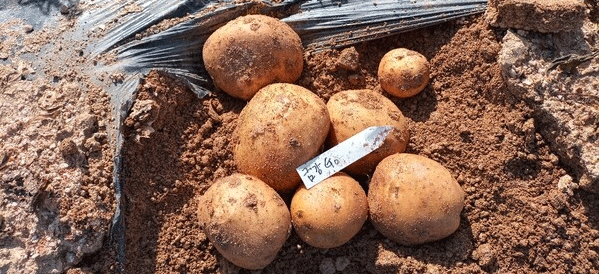
Potato breeding objectives are undergoing a significant global shift, moving from a primary focus on yield to incorporating essential traits for resilience and market specialization. The recent introduction of new cultivars by South Korea’s Rural Development Administration (RDA) and Kangwon National University illustrates this trend perfectly, presenting a portfolio of potatoes designed for specific agronomic and climatic challenges.
The described varieties offer a spectrum of targeted solutions. Seonpung (선풍) addresses production efficiency with strong resistance to common scab (Streptomyces scabies), a major soil-borne disease that degrades tuber quality, and suitability for mechanized harvesting due to its uniform, round shape. However, its noted susceptibility to late blight (Phytophthora infestans) necessitates integrated disease management, a reminder that single-gene resistance is rarely a silver bullet. In contrast, the 2022 releases Cheongchun (청춘) and Tongil (통일) are engineered for climatic resilience. Their reported tolerance to heat, drought, and viruses like Potato Virus Y (PVY) is critical, as a 2023 review in Potato Research highlighted heat stress as a growing constraint on global yields. Their exceptionally short dormancy period, enabling double-cropping (two harvests per year), represents a breakthrough in land-use intensity, particularly for regions with longer growing seasons. Posuri (포슬이) (2021), with its high starch content and dual-purpose texture—floury when boiled and crisp when fried—targets the high-value processing market, a sector demanding specific dry matter and sugar profiles.
This strategic breeding aligns with the need for “climate-smart” varieties. The International Potato Center (CIP) has long emphasized that future food security depends on crops that can withstand abiotic stresses while maintaining nutritional and culinary quality. The explicit focus on aphid/vector control for PVY-sensitive varieties like Posuri underscores the ongoing importance of integrated pest management within a resistant variety framework. The ability to double-crop with Tongil and Cheongchun can increase annual income per unit of land and improve farm-level resilience by spreading production risk across two seasons.
The new South Korean potato varieties represent a sophisticated, multi-pronged approach to modern cultivar development. They move beyond a one-size-fits-all model to offer tailored genetic solutions: Seonpung for wet, mechanized systems; Cheongchun and Tongil for climate-vulnerable regions seeking cropping intensification; and Posuri for quality-conscious processing markets. For farmers and agronomists, this signals an era where variety selection is a key strategic decision for risk management and market alignment. While these specific cultivars may be regionally adapted, the breeding principles they embody—prioritizing abiotic stress tolerance, disease resistance, and market-specific quality—are universally relevant for building more productive, resilient, and profitable potato systems worldwide.
