
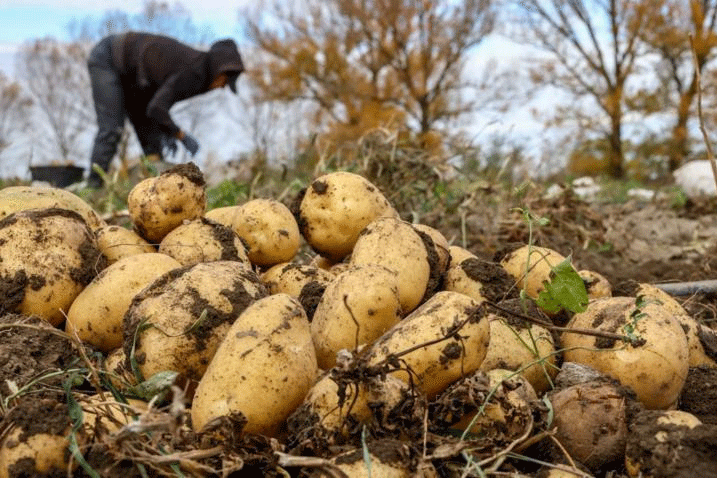
The Russian Federal Service for Intellectual Property (Rospatent) has officially registered “Tambov Potato” as a new Geographical Indication (GI). This legal status formally recognizes the intrinsic link between the product’s specific qualities and its origin in the Tambov Oblast, an area situated in the fertile Oka-Don plain within the Central Chernozem region. Rospatent explicitly highlighted the region’s ideal natural conditions—referring to its rich, black earth (Chernozem) soils and favorable climate—as the foundation for cultivating high-quality potatoes and a century-old tradition of potato farming. This action aligns with a growing global trend where GIs are used to protect and promote regional specialties, from Parma Ham in Italy to Roquefort Cheese in France. According to the World Intellectual Property Organization (WIPO), products protected by a GI often command a significant price premium, sometimes over 20-30%, due to consumer perception of higher, verifiable quality and authenticity.
The registration of “Tambov Potato” is more than a marketing tool; it is a strategic instrument for supply chain development. By legally defining the product’s geographical origin and its inherent qualities, the GI creates a protected market niche, shielding producers from generic competition and enabling them to invest in quality with the assurance of a protected return. This is part of a broader strategy in Tambov, which has already secured GIs for products like “Michurinsky” cheese. For farmers and agronomists, this underscores the increasing economic value of terroir—the unique combination of soil, topography, and climate. It incentivizes the adoption of practices that maintain soil health and optimize the specific characteristics the GI promises. Furthermore, it provides a powerful tool for export promotion, as GIs are increasingly recognized in international trade agreements, helping “Tambov Potato” gain credibility and access new markets that value certified origin and quality.
The establishment of the “Tambov Potato” Geographical Indication represents a maturation of the Russian agricultural sector, moving from volume-based production to a value-added model. It acknowledges that future competitiveness lies not only in yield and efficiency but also in the ability to create and protect unique, high-quality products that are inseparable from their place of origin. For agricultural professionals, this signals a growing opportunity to capitalize on regional strengths, integrate traditional knowledge with modern agronomy, and build resilient, profitable businesses around certified quality and brand storytelling.
