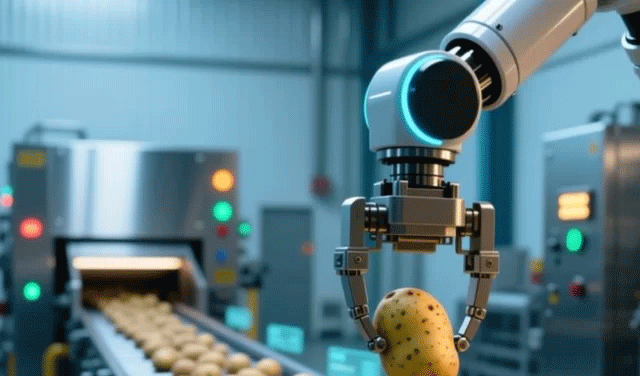
For potato producers, the post-harvest sorting process is a critical but challenging bottleneck. Reliance on human labor for grading is not only costly and slow but also prone to inconsistency and error, leading to significant financial losses from disease spread and product downgrades. Addressing this core industry challenge, researchers at Hunan Agricultural University have developed YOLO-MTP, a sophisticated deep learning model designed to automate and enhance potato quality control. Unlike many existing systems that perform a single task, YOLO-MTP is a dual-purpose tool that identifies six common surface defects—including scab, wormholes, sprouting, mechanical damage, dry rot, and bruising—while simultaneously evaluating the tuber’s overall suitability for consumption or planting.
The performance of this model is noteworthy. Internal testing has demonstrated a defect detection accuracy of over 96%, operating in real-time on a processing line. A key advantage is its ability to identify multiple, small, or overlapping defects on a single potato, a task that has traditionally been difficult for automated systems. This high level of precision is crucial. According to the Food and Agriculture Organization (FAO), post-harvest losses for root crops can exceed 30% in some developing regions, often due to inadequate sorting and storage. By rapidly identifying and removing diseased tubers like those with dry rot, systems like YOLO-MTP can directly combat these losses, protecting the quality and market value of the entire batch. This innovation arrives as the global market for AI in agriculture is projected to grow significantly, from approximately $1.7 billion in 2023 to over $4.7 billion by 2028, according to recent analysis from MarketsandMarkets, highlighting a major industry shift towards data-driven solutions.
The development of the YOLO-MTP model represents a significant leap forward in agricultural technology. It moves beyond simple automation to provide intelligent, multi-faceted quality assessment that surpasses human capability in speed and consistency. For farmers, agronomists, and engineers, the implications are substantial: reduced reliance on scarce labor, minimized post-harvest losses, improved disease management, and higher overall product quality. While currently a research prototype, its potential for integration into commercial sorting machinery and even adaptation for other crops positions it as a foundational technology for the future of efficient and sustainable potato production.
