
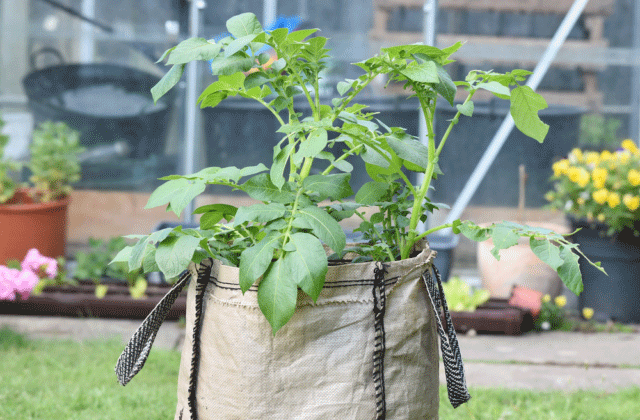
A recent proposal by a Russian economist has sparked discussion within the agricultural sector: cultivating potatoes in urban apartments to help bridge the nation’s annual production gap. It is suggested that Russia needs to increase potato production by 4.5–6% annually to meet domestic demand. The claim is that leveraging indoor, soilless cultivation could address 8–10% of this shortfall, potentially yielding an additional 132 million kilograms from approximately 550,000 urban households.
The proposal is linked to a new, reportedly simplified cultivation method developed by domestic researchers that promises year-round, chemical-free production without specialized equipment. The economist’s calculations are precise: utilizing a 6 sq. m. space, planting 5 plants per sq. m., with a yield of 2 kg per plant, harvested four times a year, could theoretically provide 240 kg of potatoes for a family of four. With 75% of Russia’s population (over 109 million people) living in cities, the model targets the 5% who might garden as a hobby and the 2% who would do so for sustenance.
However, from an agronomic and economic standpoint, these figures demand scrutiny. Achieving a consistent 2 kg per plant yield indoors, even with optimized conditions, is highly ambitious. For context, open-field potato yields in Russia have shown volatility. According to data from the Russian Federal State Statistics Service (Rosstat) and the FAO, the national average yield can fluctuate significantly based on weather, with 2022 yields reported in the range of 17-19 tons per hectare (approx. 1.7 – 1.9 kg per sq. m., not per plant). Furthermore, the proposal concedes its own limitations, stating that any gains from such small-scale production would likely be offset by declining overall productivity in the professional sector and rising import levels, thus exerting no downward pressure on market prices.
While the concept of urban agriculture promotes food sovereignty and engages citizens, positioning indoor potato cultivation as a meaningful solution to a national production deficit is unrealistic. The model overlooks critical challenges: the high energy costs for artificial growing environments, the expertise required for consistent indoor horticulture, disease management in confined spaces, and the vast economic inefficiency compared to scaled field production. For agronomists and policymakers, the focus must remain on supporting professional farmers through advanced seed genetics, sustainable land management, modern storage infrastructure, and smart trade policies. Apartment farming may serve as an educational hobby or provide fresh produce for a few households, but it is not a substitute for a robust, efficient, and scalable agricultural system.
