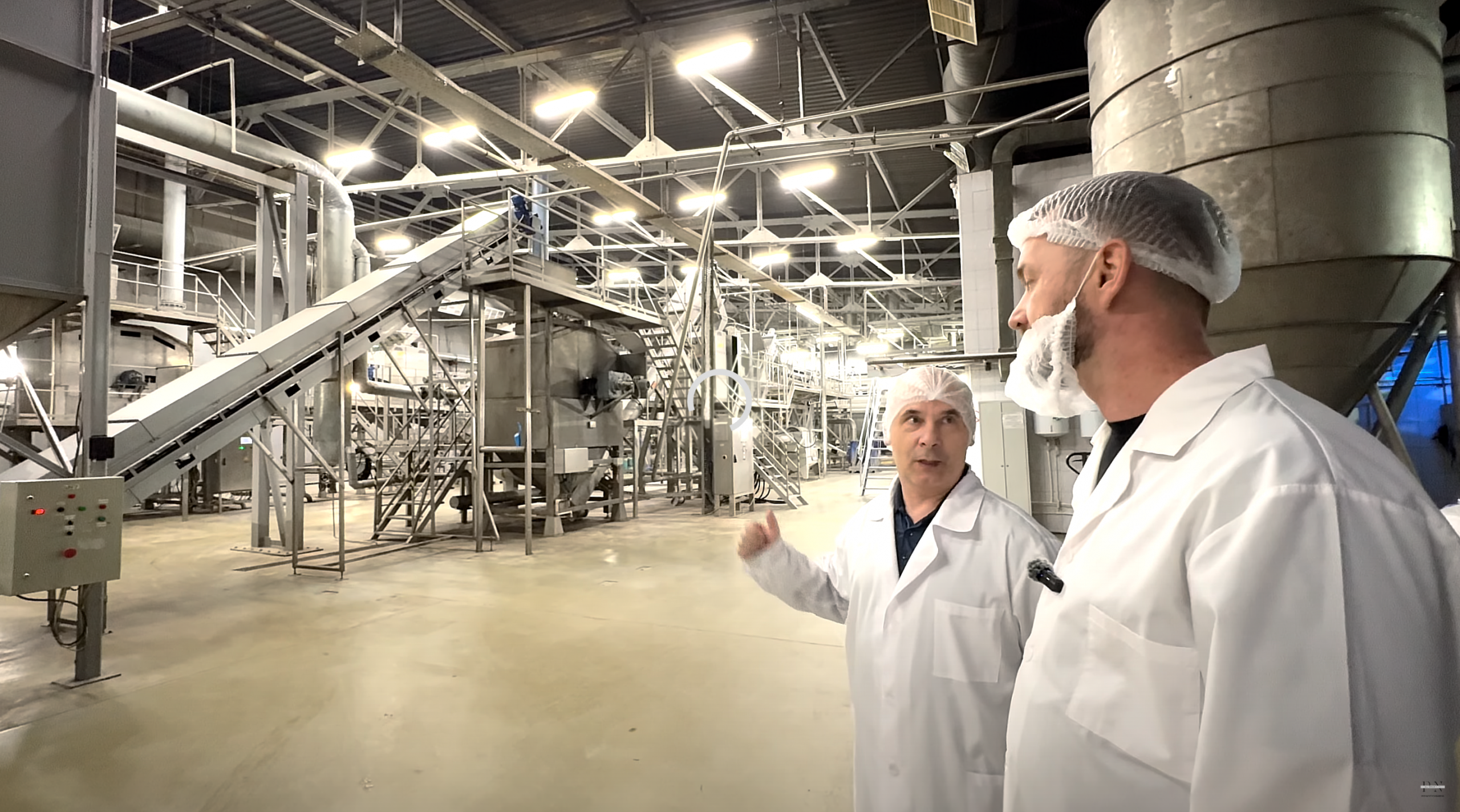
interview recorded during the “Potato Tour of Russia” at the Maxim Gorky Plus plant. Spokesperson — executive director Alexandra Ponomarenko.
Key points
- Raw material quality is everything. The plant deliberately rejects part of incoming potatoes: “processing for the sake of processing” produces gray color, foreign specks, and poor taste.
- High raw-potato prices ≠ higher margin. As potatoes get pricier, flakes get pricier too, but the processor’s spread doesn’t grow. Risk: if prices de-couple, the gap will be filled by imports.
- Answer: contracting. The 2025 season pushes processors to fix prices and volumes with farmers before the season and to cut output when there isn’t enough quality raw material.
- Automation & closed loop. The line is as sealed as possible: steam-peeling, inspection, blanching, cooking, drum drying, pneumatic transport, milling, packaging—minimizing human factor.
Season economics: expensive raw potatoes and a tight demand ceiling
“The problem isn’t high potato prices per se; the flake market won’t stretch forever. You can raise price lists, but the consumer range is limited—and the processor’s margin doesn’t rise.”
Without longer-term contracts and a fair balance between raw price ↔ flake price, domestic players will struggle to compete, opening the door to imported products.
Why “not all raw material is raw material”
Critical defects on intake:
- high contamination and skin residues;
- low dry matter (fresh, immature tubers);
- mechanical damage without proper washing/cleaning.
In the bowl: grayish color after reconstitution, dark specks, pepper-like fines, off bulk density—this product fails spec.
“Whether the field price is 10 or 20 rubles per kilo, what matters is the cup result. You can’t make quality flakes from sub-standard potatoes.”
Why timing and dry matter matter
Technologists note: September–October (better October–November) gives much higher dry-matter yield than “July fresh.” Practices like desiccation/haulm killing and letting tubers rest before harvest aren’t rituals—they’re dry-down technology.
How potato flakes are made: the line at a glance
- Washing → steam-peeling. Steam removes skin, followed by final cleaning.
- Inspection table. Defect removal and stream selection.
- Cutting. Slice thickness per customer spec.
- Blanching → cooking. Mass preparation for drying; operator controls consistency before the drum.
- Drum drying. A uniform “sheet” of flakes forms; ideally it releases from the drum by itself.
- Pneumatic conveying (closed loop). No open trays or manual handling.
- Coarse milling → surge bins. Staging for packing.
- Packaging. Big bags / poly / paper — a set of optimized specs for palletization and logistics.
“In automation and spec discipline we’re among the leaders: sealed vessels, pneumo lines, minimal intervention—maximum repeatability.”
The plant’s stance toward the market and growers
- Open to cooperation, but strictly on win–win terms—balanced prices and quality.
- Ready to fix price and volumes pre-season to avoid price whiplash and quality shortages.
- If needed, they reduce output rather than “stuff” the line with non-conforming raw material.
“Spec, as a technologist sees it”
- Color: even, appealing yellow with no gray.
- Fraction: uniform, without excessive fines.
- Inclusions: no dark specks.
- Reconstitution: no free water; stable texture.
In their own words
“We’re not here to process everything that shows up—we’re here to make a quality product from quality raw material.”
“Even in a raw-material shortage we turn trucks around—not everything should be processed.”
“Contracting and disciplined supply are the only way everyone gets through the season without losses.”