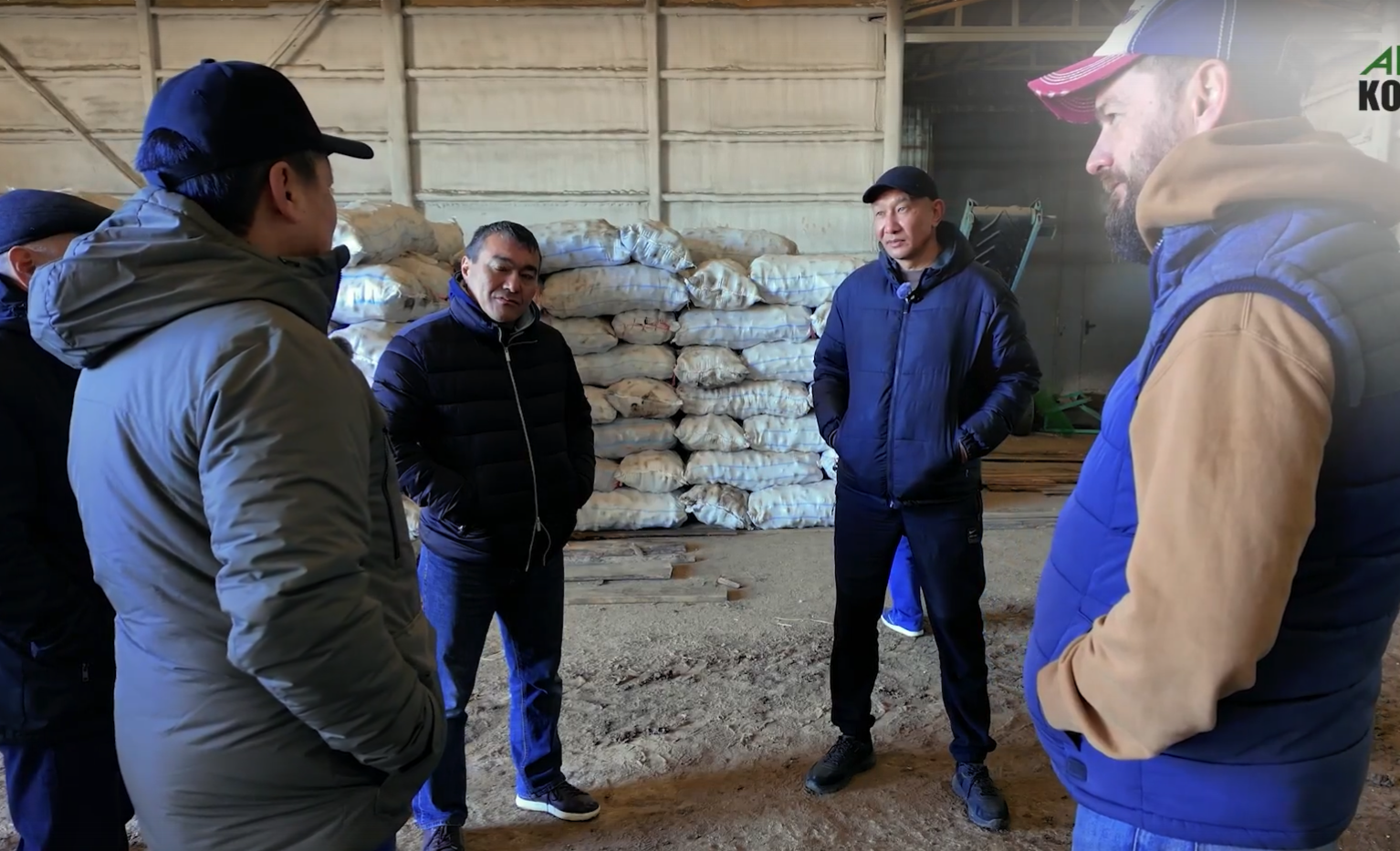
The International Potato Tour continues its journey across Kazakhstan.
This time, the Potatoes.News team visited the Pavlodar region and the farming enterprise TO “Agroterra” — a business that has grown from small experiments to large-scale, professional potato production.
Farmers shared their experience from the difficult 2024 season, explained why planting dates became a critical factor, discussed the performance of Chinese seed potatoes, and revealed how they work with Avgust, one of the most influential crop protection companies in the CIS region.
Seven Years of Growth: From Two Hectares to a Full-Scale Operation
The farm’s founder recalls humble beginnings:
“We came here in 2017. Started with only two hectares, old equipment, no irrigation. Just experimenting. We sold potatoes at 15 tenge per kilo back then. Today we operate hundreds of hectares with a proper irrigation system.”
The family’s connection to potato farming goes back decades — a large family, annual planting traditions, and early entrepreneurial thinking.
Professional Farming: Mechanization, Teamwork, and the High Cost of Mistakes
The farmer emphasizes:
“Large-scale work is nothing like a household garden. Mechanization, planning, and a strong team are everything. The cost of a mistake is high. Planting and harvesting timing is crucial. If you get these right, the rest becomes a professional routine.”
The 2024 Season: A Difficult Year Shaped by Rain and Muddy Planting
The 2024 season was one of the toughest for Agroterra:
- Unexpected, prolonged spring rains
- Forced planting into wet soil (“planting in mud”)
- Reduced emergence due to soil compaction
- A sharp drop in yield
“Some of the crop was planted before the rains — and that gave around 40 tons. But what we planted in mud got suffocated. The yield dropped significantly.”
Late Blight Pressure: Five Fungicide Applications in One Season
August brought heavy late blight pressure to the region.
The farm applied five fungicide treatments, balancing between rain delays and irrigation needs.
Working with Avgust, they focus on finding solutions that target resistance issues and introduce new active ingredients (AIs).
Avgust’s representative explains:
“Our goal isn’t just selling products — it’s solving problems. We bring new AIs, new formulations, and help farmers overcome resistance. Each case needs a tailor-made solution.”
Chinese Seed Potatoes: Surprisingly Strong Performance
One of the most intriguing parts of the interview was the discussion of Chinese seed potatoes received through Mongolia.
Despite mixed expectations, the farmer notes:
- strong tuber quality
- good vigor
- acceptable documentation with Beijing certification
- strong performance in Kazakhstan’s climate
“China is huge and open. We visited a seed farm producing 60,000 tons of seed potatoes. The potential is impressive.”
There were inconsistencies between truckloads — likely due to loading practices — but overall results exceeded expectations.
The ‘1.5 kg’ Market: How Uzbekistan Influenced Local Production
The farmer explained a unique market segment known as “1.5 kg potatoes” — small tuber fractions.
“Uzbekistan used to demand this small fraction for low price retail. It shaped part of the market. But we focus more on quality commercial fractions above 40mm.”
Processing Contracts: PepsiCo, Chip Production, Balmatika
Agroterra is moving towards the processing market:
- negotiations with PepsiCo
- discussions with Chip Production
- interest from Balmatika
This echoes a broader regional trend — increasing demand for chip and french fry varieties under contract farming.
Fertilization Strategy: Balanced Approach for 40 t/ha
The farm applies:
- Diammonium phosphate (DAP) — around 500 kg/ha
- Ammonium nitrate
- Nutrient mixes applied directly into the ridge
Target yield: 40 tons of high-quality potatoes per hectare, without excessive nutrient application.
Crop Rotation: Lentils, Flax, Barley, Wheat
A well-structured crop rotation supports soil health:
- lentils
- flax
- barley
- wheat
Flax was a pleasant surprise:
“It’s drought-tolerant, profitable, and leaves the soil soft and fertile. It’s an excellent predecessor.”
Conclusion
The experience of TO “Agroterra” demonstrates:
- Timing of planting and harvesting is the key success factor
- Chinese seed potatoes are becoming a real alternative for commercial farms
- Late blight remains a major challenge requiring modern AIs and resistance management
- Avgust plays a strong role as a technical partner, not just a supplier
- The processing sector is creating new opportunities in Kazakhstan
- Smart crop rotation is essential for stability in semi-arid regions
The International Potato Tour continues capturing real stories, real problems, and real solutions from potato growers across Kazakhstan.