
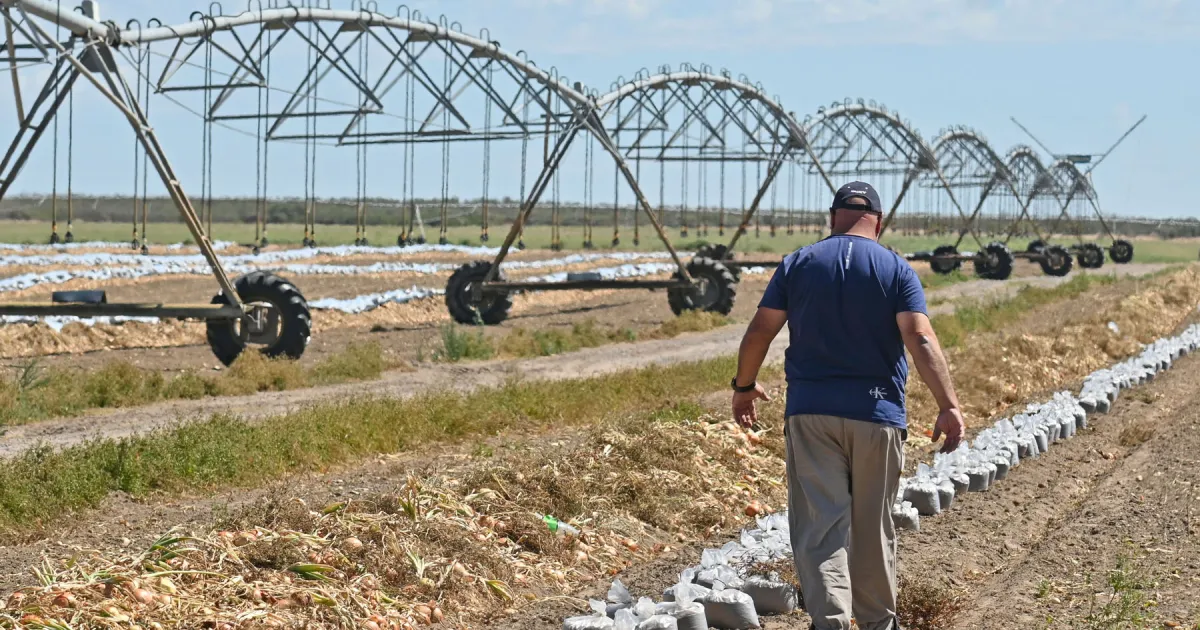
In Argentina’s Patagonia region, potato farming is gaining new momentum thanks to the use of center pivot irrigation systems in traditionally arid zones. According to Argenpapa, the adoption of modern irrigation and soil management technologies is transforming dry lands in areas such as the Río Negro Valley and Carmen de Patagones into productive potato fields.
Source: Argenpapa.com.ar
A New Frontier for Potato Production
While Argentina’s main potato-growing areas have long been located in the country’s temperate northern and central provinces, producers in Patagonia are now proving that with the right technology and crop rotation, quality potatoes can be grown even in semi-arid environments.
Agronomist and producer Martín Pasman, who manages farms in Carmen de Patagones (Buenos Aires) and Luis Beltrán (Río Negro), has successfully implemented an integrated system of irrigation, rotation, and precision management to cultivate potatoes, wheat, onions, and corn.
Technology at the Core: Pivot Irrigation
The key to this transformation lies in precision irrigation. Using center pivots, Pasman applies between 800 and 900 mm of water per cycle, carefully adjusted to the soil’s capacity and the crop’s evapotranspiration needs.
“With pivot irrigation, we can go very fine — giving the soil exactly what it can retain, without excess,” he explains.
Each field is mapped by soil type, and irrigation speed is adjusted accordingly — slower in sandy zones, faster in clay-rich areas — ensuring optimal moisture distribution and higher yield efficiency.
Crop Rotation and Soil Management
Crop rotation plays a crucial role in maintaining soil health and productivity. The rotation pattern typically follows:
Potato → Wheat → Onion → Wheat → Potato → Wheat → Wheat → Potato,
with land use roughly divided into 25 % potato, 50 % wheat, 12.5 % onion, and 12.5 % corn.
This structure supports both soil recovery and water efficiency while providing economic stability through diversified production.
Advantages and Challenges
Key Advantages:
- Productive use of underutilized arid land through controlled irrigation.
- Water efficiency and reduced waste via precision application.
- Enhanced soil sustainability and yield stability through rotation.
- Expansion of Argentina’s potato supply base beyond traditional zones.
Main Challenges:
- High initial investment in pivot systems, mapping, and monitoring technology.
- Need for continuous technical oversight and maintenance.
- Logistics and cost competitiveness compared with established production regions.
- Adapting varieties to Patagonian climate conditions and daylight cycles.
Outlook
The expansion of potato cultivation in Patagonia represents a promising diversification opportunity for Argentina’s potato industry. By combining advanced irrigation, crop management, and soil care, producers can achieve sustainable growth and mitigate regional climate risks.
If supported by continued innovation and infrastructure, the Patagonian model could soon become a reference point for efficient potato production under arid conditions.
Article prepared exclusively for Potatoes.News based on material from argenpapa.com.ar/noticia/16675