
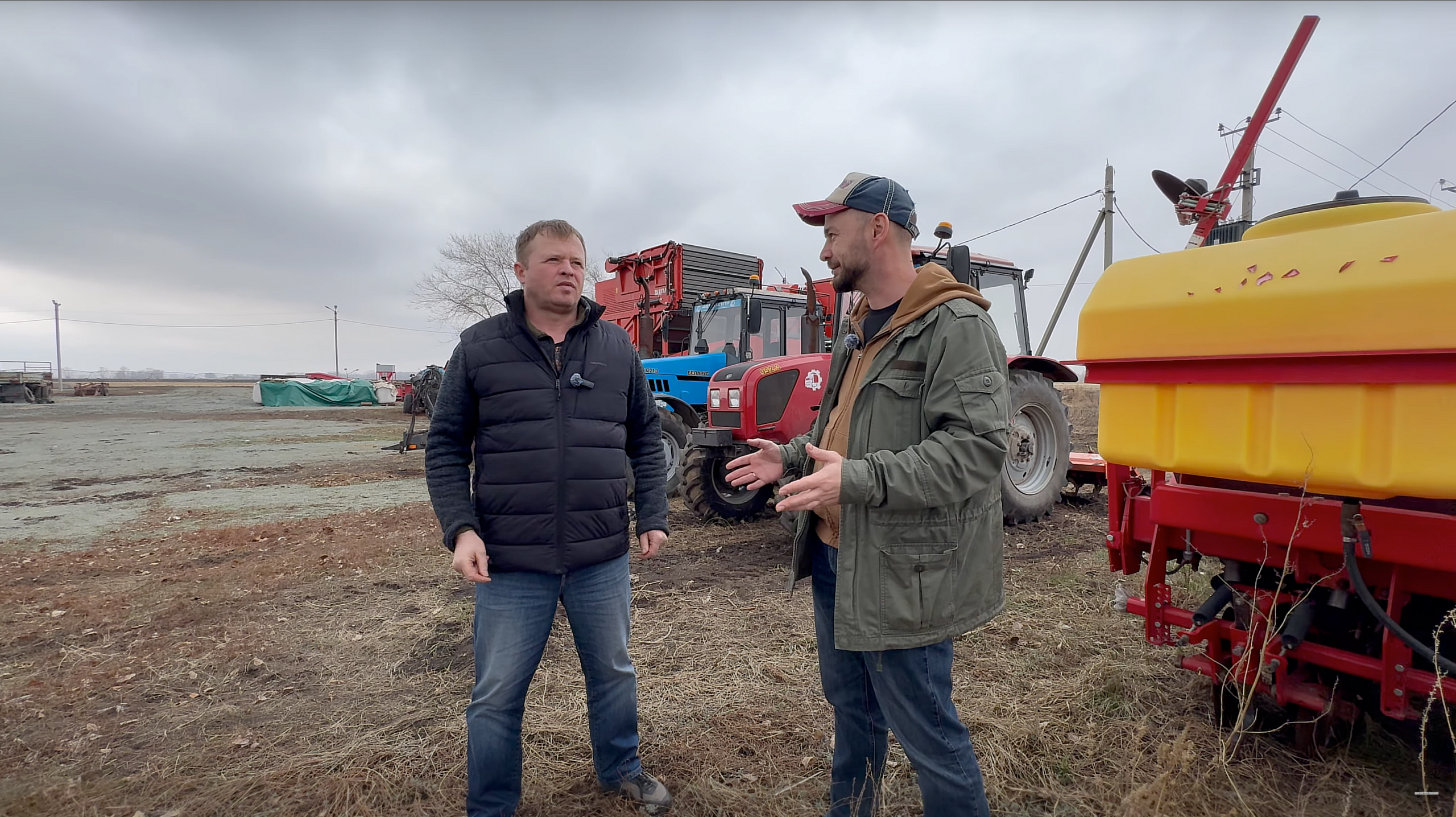
interview recorded during the “Potato Tour of Russia” (Orenburg Oblast, Ursky District).
In the floodplains of the Kumak and Ural rivers, potato farming is always about managing water risk. In 2023, heavy rains ruined harvest; in 2024, the Ural burst its banks. “We lived on a boat,” recalls the team at Alexander Shcherbakov’s farm. The water came fast, carried off hay bales, dumped wood debris, carved gullies, and—most painfully—washed away the fertile topsoil. Center-pivot machines stood in water; hay and branches floated across fields; along the edges, you could still see “a sea” where potato tops should have been.
From a state vegetable farm to private initiative
Historically, this was a vegetable state farm: in the 2000s there was full infrastructure (Fregat sprinkler lines, storage, mains). Later everything was stripped for scrap; slabs and blocks were taken—city proximity worked against farmers. Today, the team is rebuilding the chain from scratch: a repair area, on-field sorting (so you don’t haul soil to the warehouse), and gradual upgrades of key machinery.
The farm: scale, people, equipment
- Start & growth. In agriculture since 2003; the farm was officially registered on 13 April 2016.
- Area. Target ~150 ha of potatoes (subject to flood recovery).
- People. Core staff are local young men—“no one quit.” But there’s a persistent shortage of qualified tractor operators and drivers. Manual work is being replaced by machines, but skills remain a bottleneck.
- Equipment. In 2019 they upgraded key links: planter, bed former, harvester. Sorting is done right at the field to avoid hauling soil.
Seed and market demand
This season’s biggest headache is a seed shortage for the popular table variety Gala. The market has “acquired the taste”: Gala is “attractive and delicious,” with reliable cooking quality. The farm is open to seed offers.
Damage, support, and sales
They did harvest some crop after the flooding, but quality suffered: the loss of topsoil hit marketability and storability, prices are lower, and significant volumes went to processing (washing, peeling; school and preschool supply). The state compensated a large share of the loss—the money mainly covered loans and leasing payments.
Sales geography—a chance to grow
Nearby is a large city (~250,000 people) and a region where up to 90% of potatoes are imported. The sales potential is obvious: once weather normalizes and soil profiles are restored, the farm plans to at least hold area, and, conditions permitting, expand.
Water: threat and asset
Floodplain means risk and advantage at once. You can still see pockets of standing water, and on the horizon the traces of center pivots that could be expanded “as in the state-farm years”—to ~500 ha under irrigation. But first things first: land reclamation—leveling fields, rebuilding topsoil, and draining weak spots.
In their own words
- “The water came in a flash… we lived on a boat. We collected everything that floated up.”
- “There isn’t enough Gala seed. The market wants it—it’s attractive and tasty.”
- “There’s demand, but after the floods much goes to processing.”
- “The team held—no one left when things got scary.”
What’s next
Plans for the season are sober: hold the line, strengthen the seed shield, tighten up machinery and staffing. Longer term: return to wider irrigation and contract-based supply. There’s a solvent consumer next door, and quality local product is still in short supply for retail and processors.