
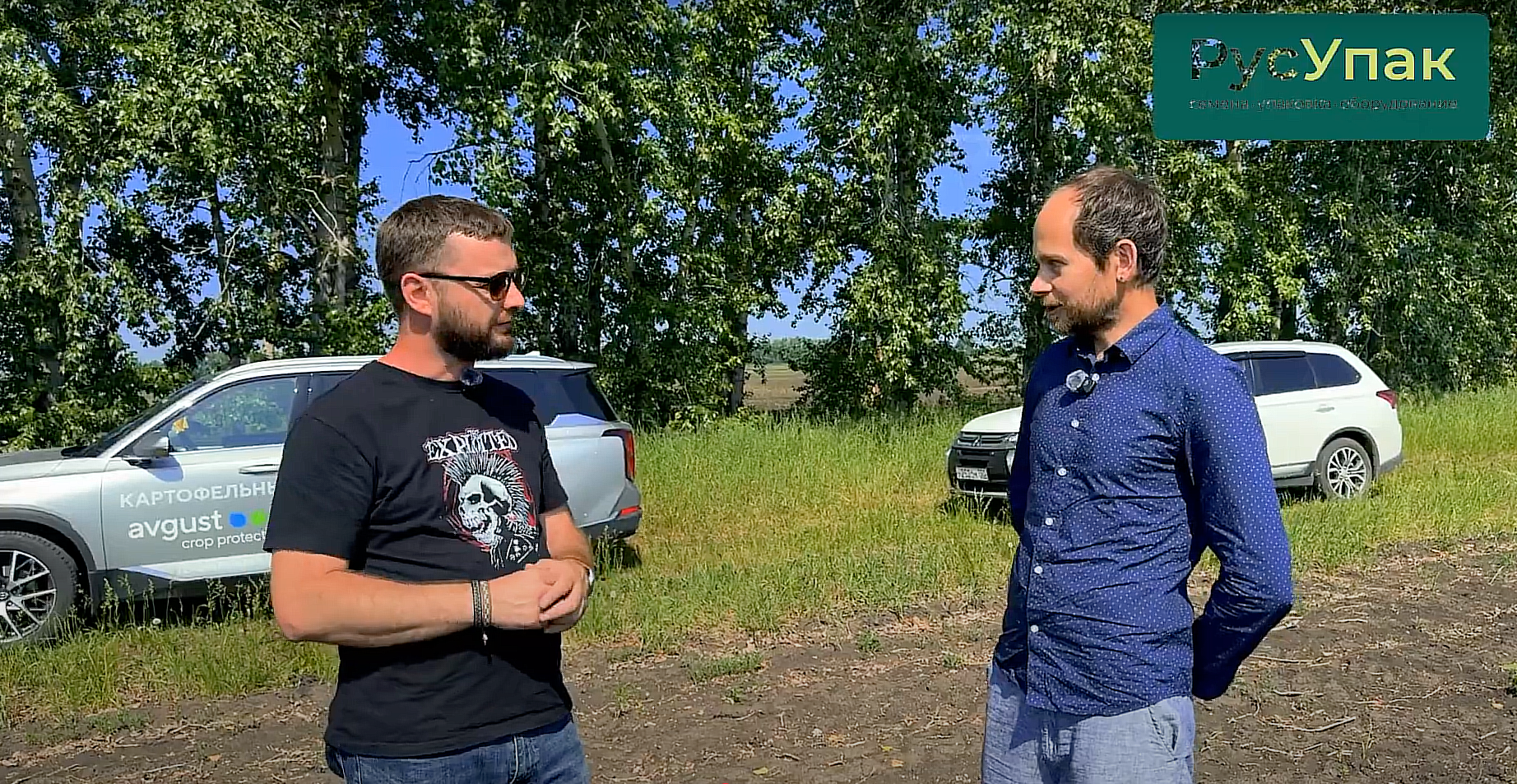
At the Krasnoyarsk Agrarian University, a Center for Breeding and Seed Production runs parallel programs in potatoes and soybean: testing rotations, multiplying high seed classes, advancing lines toward the State Register, and—together with Avgust—trialing protection schemes on demo plots. Core takeaways: soy in rotation with potatoes works, seed class strongly drives yield and storability, and there are no “perfect” cultivars—breeding balances earliness, productivity, and resistance.
Who and where
- Krasnoyarsk Agrarian University, Center for Breeding & Seed Production.
- Focus: potatoes and soy (started with soy; potatoes added later).
- Pipeline: from breeding (tough “low-input” background) → seed production (high-input agronomy + protection) → handoff to growers.
Crop rotation: why soy ↔ potato
- Soy after potatoes is a strong predecessor: cleaner field, residual fertility still “works,” and herbicide compatibility reduces carryover risks.
- Soy adds symbiotic nitrogen, substantial residues, and a positive organic matter balance (confirmed by soil studies).
Market demand and breeding trade-offs
- Local consumers and retail want large, yellow-fleshed, tasty potatoes with solid disease resistance.
- Gala led for years but often skews too many small tubers (many-tuber trait), so growers are moving on.
- A typical “impossible brief”: very early + very high yielding + broadly resistant. Reality demands balance.
- Myth: “more starch = better taste.” In practice, starch and eating quality aren’t the same thing.
New varieties and the “star series”
- Acrux — listed in the State Register (2025) for Zones 10–11 (Western & Eastern Siberia).
- Mira (in trials): targeted at large table potatoes; demo results reached ~40 t/ha.
- A promising purple-fleshed line is in the pipeline; naming will keep the star-themed convention.
Seed production: class matters
- Plots include super-super-elite plantings (some material shifted to super-elite to ease market adoption).
- Seed fields target grade/size profile, not maximum tonnage; typical range ~20–25 t/ha for seed production.
- Demonstrations show clear gaps between SSE/SE vs. reproduction classes—measurable yield lifts (e.g., +6 t/ha in trials).
- Reminder: small table fraction ≠ seed. “Refresh every 5–6 years” leads to planting-stock degradation.
Soils and adaptation
- Leached chernozems with high fertility—but heavy loams aren’t ideal for long-oval types (deeper eyes, poorer shape).
- Regional pattern: early-summer drought followed by cool, wet late season. Breeding selects for adaptation; final stages test max yield potential under high agronomy.
Crop protection: can you save on CP with elite seed?
- Planting elite/high classes does not automatically cut crop-protection needs; resistance is cultivar-specific.
- Some reproduction fields may safely skip a pass (e.g., one fewer spray in certain contexts), but on high classes the recommendation is to run full programs.
- With Avgust, the center runs demo trials (herbicides/fungicides/insecticides) and designs anti-resistance schemes.
Education and events
- Joint Spring Fieldwork 2025 recommendations published with Avgust; ongoing grower training.
- July 31 – August 1 — free, two-day scientific & practical seminar:
- Day 1 — theory (nutrition, protection, tillage, breeding & seed potatoes).
- Day 2 — field visits.
- Participants receive a professional development certificate.
- Registration via district agricultural departments.
- Contact: Pavel Stolyar, Head of Avgust’s Krasnoyarsk branch.
Key facts (at a glance)
- Rotation potato ↔ soy: boosts organic matter and N.
- Market wants large, yellow tubers; Gala sliding due to size profile.
- Acrux in State Register (2025), Zones 10–11.
- Seed fields: 20–25 t/ha target; table trials up to ~40 t/ha.
- Higher seed class = higher yield & storability; small table potatoes are not seed.
- CP: skimping on high classes is risky; tailor programs to cultivar and agronomy.
Quotes
- “Soy after potatoes is a strong predecessor: cleaner field, better fertility, herbicide compatibility.”
- “There are no perfect cultivars—we balance earliness, yield, and resistance.”
- “The gap between SSE/SE and reproductions still surprises us each year.”
- “Elite seed isn’t a reason to cut protection: savings, if any, appear on some reproduction fields.”
Bottom line
The Krasnoyarsk team shows how science → seed → field should flow: disciplined rotation, rigorous seed class management, honest protection schemes, and breeding for real-world demand (large grade, resilience, adaptation). The “star series,” from Acrux onward, has a real shot at becoming a regional standard.
Preview / Teaser (for social)
Krasnoyarsk: breeding, seed potatoes, and crop protection. Soy in rotation, “star-series” cultivars (Acrux, Mira), why elite seed doesn’t mean cheaper CP—and a free seminar July 31–Aug 1. Details in our Potato Tour report.
Watch the new video and support us: subscribe, comment, and share if you found it useful!
VK: https://vk.com/potatoholic · YouTube: https://www.youtube.com/@POTATOESNEWS · TikTok: https://www.tiktok.com/@potatoes.news