
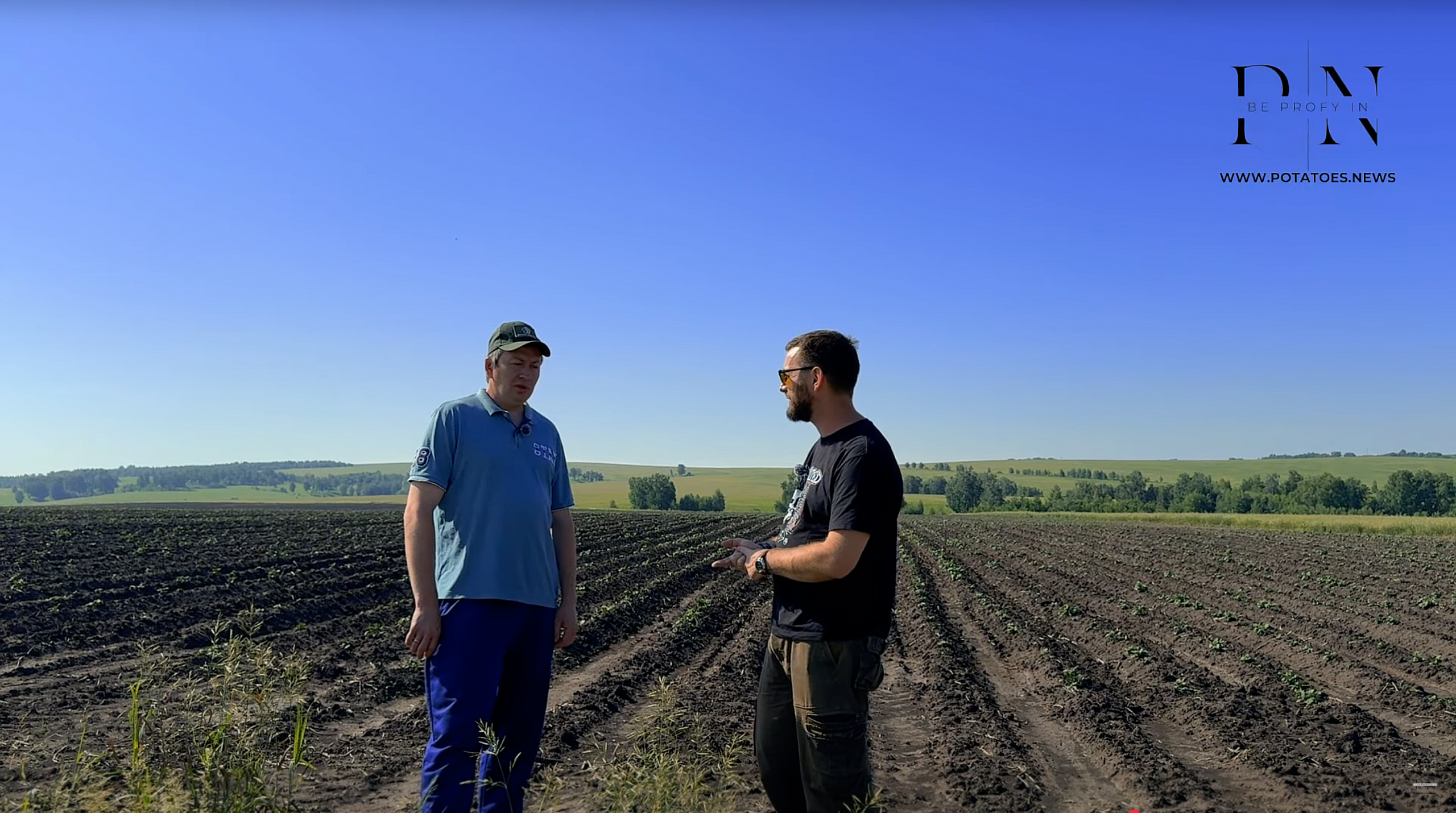
Krasnoyarsk Krai, Berezovsky District
What’s inside. The International Potato Tour continues. Our guest is farmer Anton Chebotnikov. We discuss how to build a stable farm without chasing acreage: prioritize quality, track unit costs, catch the harvest window before frosts, and stay competitive—even when imports pressure the market.
How it started
Anton officially became a farmer in 2011. The path began with organics (manure, compost) and a chance purchase of a Dominator fertilizer spreader from a neighboring farmer—an “vegetable” machine that nudged him toward potatoes: 2.5 ha → 5 → 10 ha, which remained the optimal scale for a long time. Before farming, Anton worked for the railway but deliberately chose the harder road—farming.
Farm philosophy: “add quality, not hectares”
No plans to expand land “at any cost.” Priorities are higher yields and quality, plus mechanized harvesting of carrots and beets. Potatoes are a key crop. Varieties are mainly NORIKA; among red ultra-early types he notes Senebel, now gaining popularity in southern regions.
Calendar & climate: working ahead of autumn
Early night frosts are normal in the Berezovsky area. In some years –7 °C arrives as early as the 20s of September.
Tactics:
- Potatoes are lifted by September 25 to avoid frozen ridges.
- Then the team switches to carrot harvest (late September–early October).
- Beets follow as fields are ready.
Market 2025: how China flattened the spring price
This year Chinese potatoes are again visible in Siberia—very large calibers with aggressive pricing in April–June. Where retail chains had haggled around ₽65/kg in April, big lots pushed prices down to ₽36–38/kg. The takeaway is simple: without tight cost control and consistent quality, it’s hard to compete.
Unit-cost levers
- High-quality seed is foundational.
- Focus on size fraction and uniformity (critical when imports sway the market).
- Tight scheduling around likely frosts: harvest delays = direct losses.
- Mechanize the most labor-intensive bottlenecks (root crops) to free capacity.
“Every year brings a new task”
Each season Anton sees new diseases and pests. This year brought a surge of an unidentified moth, which still needs proper ID and risk assessment. The response is practical exchange with agronomists and neighbors, small-lot testing, and fast adjustments to crop protection.
Learning & people
Anton isn’t an agronomist by training, but 13+ years in the field built a practical school: peer talks, short feedback loops, minimal dogma. His view on education is straightforward: universities should provide basics and work ethic; specific technologies will always differ farm to farm.
A bit personal
A long-standing goal is to finish the family home and move in. About his son, he’s clear: he won’t push him to farm—what matters is being in harmony with oneself. A simple mental tool he uses: rename “problems” to “tasks.” Tasks invite plans.
Takeaways for peers
- Don’t chase hectares if you can grow yield and quality first.
- In Siberia the frost calendar rules—lift potatoes before the freeze.
- Unit cost wins: only farms that know their numbers survive import price swings.
- Mechanize bottlenecks (carrot/beet harvest) for real savings.
- Update knowledge constantly—new pests and diseases are an annual reality.
Quick facts
- Location: Krasnoyarsk Krai, Berezovsky District
- Profile: potatoes, carrots, beets
- Potato varieties: mainly NORIKA; among early reds — Senebel
- Harvest rhythm: potatoes by Sept 25 (before steady sub-zero nights), then carrots/beets
Prepared as part of the International Potato Tour (Международный картофельный тур)—a series of field stories and interviews about the people, technologies, and markets of potatoes.