
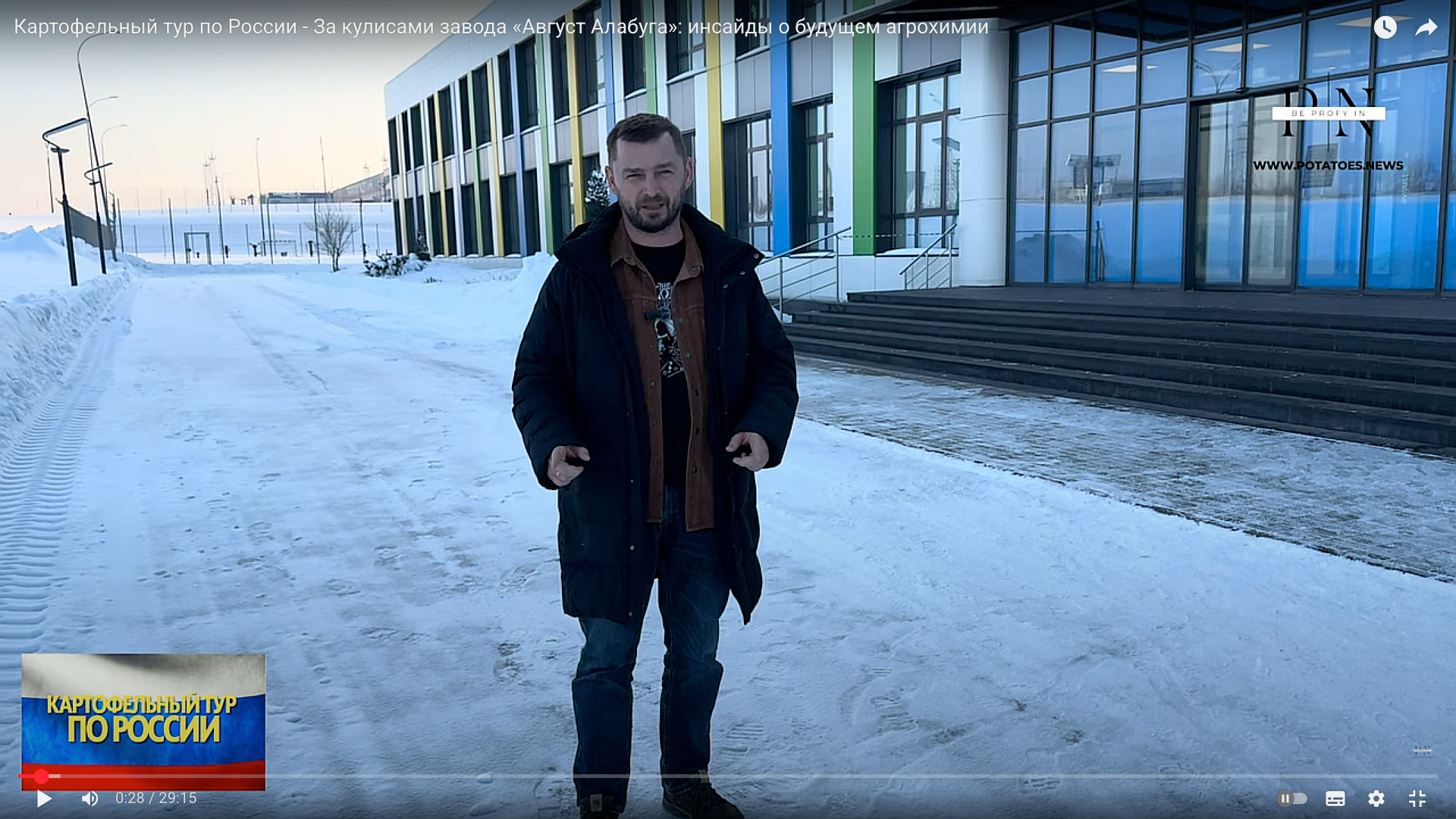
A “Potato Tour across Russia” visit to the Republic of Tatarstan, to the project’s general partner — Avgust
Avgust guided us through its complex in the Alabuga Special Economic Zone (SEZ). On a single site the company has integrated raw-material reception, production and logistics circuits, plus quality-control labs — from inbound materials to finished products ready for the peak spring season.
Production flow: from raw materials to finished goods
- Raw-materials warehouse: reception of bulk and liquid inputs (drums, IBCs); a separate, remote flammable-liquids (FL) block for solvents and bulk components.
- Polymer packaging shop: in-house production of canisters and other containers.
- Formulation shops: herbicides (Building 5); fungicides, insecticides, and seed treatments (Building 6).
- Finished-goods warehouse: large capacity to cover highly seasonal spring demand without shuttling between multiple sites.
All buildings are linked by enclosed galleries so people and flows move indoors without crossing raw and finished streams.
Quality and traceability
Samples from production are labeled with a barcode at draw time and handed over at a dedicated point; results are logged in SAP, ensuring full batch traceability.
Separately, Avgust runs a GS1-based track-and-trace system: each unit (canister, bag, pallet) carries a unique data code that can be verified by phone and used for stock tracking. The company emphasizes it launched this system before state labeling initiatives.
Why Alabuga: speed and infrastructure
The need to expand capacity crystallized in 2015. Expanding on the legacy site meant years of land-title work with dozens of owners. In Alabuga, Avgust received a ~17.7-ha plot with free utility hookups at the boundary (power, gas, heat, water, sewer) and a clear lease (~₽1.3 m/year).
Timeline: SEZ residency — 2016, piling — spring 2017, first output — May 2019, ceremonial opening with the President of the Republic of Tatarstan and Russia’s Ministry of Industry — June 2019.
Capacities and growth
- Current production season output: ~25.5 million liters.
- Design capacity: up to 50 million liters, to be phased in.
- Average annual volume growth: +10–15%.
Recent regulatory changes (decisions adopted late last year) allow export-only formulations not registered in Russia (e.g., cotton defoliants), enabling a broader export line once by-laws are in force.
Geography and market
On Russia’s crop-protection market, Avgust’s share equals every 4th–5th hectare when measured as hectares of single-application treatments. Abroad, Latin America is the key growth vector (Peru, Colombia, Ecuador; in Brazil Avgust works via major international distributors). To track real dynamics, the company measures treated hectares, not revenue, given undercounting of certain products in third-party analytics.
Own chemistry and active ingredients (AIs)
Avgust operates three formulation plants (including one in Belarus) and a full AI plant in Hubei, China. Currently 6–7 AIs are in production (plans are broader), including full tebuconazole and a significant share of propiconazole; some AIs are sold externally. The China location reflects access to fine (low-tonnage) chemistry.
Avgust Polymer: grain bags and films
In Alabuga, Avgust is building Avgust Polymer to produce grain-storage bags and technical films (silage, covering, greenhouse). The core is a blown-film line with a 2-m die head forming sleeves up to 5 m wide; the sleeve is drawn ~20 m vertically for polymerization (equipment height ~34 m). The project covers a niche previously supplied by imports.
R&D and talent
In Moscow, Avgust is finishing a ~25,000 m² R&D Center (excluding greenhouses):
- Chemical cluster — synthesis of existing AIs and co-formulants.
- Biological cluster — 30+ controlled-climate labs to test bio-efficacy and optimize formulations.
The company highlights the sector’s main bottleneck: people. Avgust is expanding in-house advisory and laboratory support for partners.
Social projects
Avgust invests in local social infrastructure where it operates: sports facilities, parks, housing, and schools (including a new school in Chernogolovka), following the principle “we earn in the country — we invest in the country.”
Key facts (summary)
- Alabuga SEZ: integrated flow — raw materials → formulation shops → large finished-goods warehouse.
- Full traceability: barcodes + SAP, proprietary GS1 track-and-trace.
- Capacity: 25.5 m L/season now; 50 m L design.
- Export line: expansion enabled by regulatory updates.
- R&D: ~25,000 m² center, 30+ climate labs.
- Polymers: Avgust Polymer (grain bags, films).
Prepared as part of the “Potato Tour across Russia” project together with the general partner — Avgust.