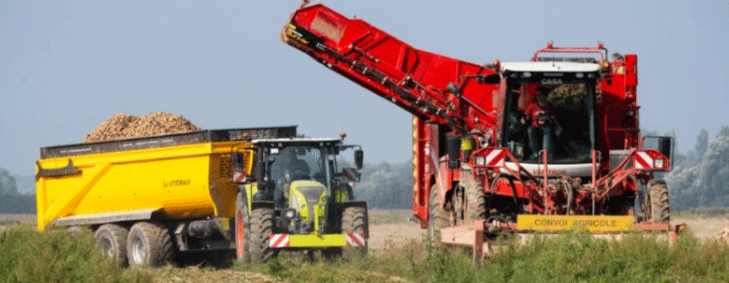
A quiet revolution is transforming the European potato landscape, and its epicenter is in France. Long overshadowed by processing giants Belgium and the Netherlands, France has emerged as Europe’s fastest-growing potato processing hub, with profound implications for farmers, agricultural engineers, and processors across the continent. New data reveals that French processors handled 1.6 million tons of potatoes in the first three quarters of the 2024-2025 season—a staggering 23% increase over the previous year. This explosive growth, driven by billions in foreign and domestic investment, is reshaping traditional supply chains, altering planting strategies, and creating both opportunities and market uncertainties for agricultural professionals.
The Processing Boom: Frozen Fries Drive Unprecedented Growth
The engine of France’s transformation is its rapidly expanding processing capacity, particularly in the frozen french fry sector that accounts for two-thirds of all processed potatoes. Chips represent 14% of production, followed by dried products like mashed potato flakes (13%) and other products (6%). This processing surge has been fueled by major infrastructure projects, including:
- A new factory from Belgian frites producer Clarebout
- New facilities from Ecofrost and Agristo
- Expansion projects by global leader McCain
This concentration of investment has created a processing juggernaut that is rapidly closing the gap with traditional leaders. While the Netherlands (4 million tons) and Belgium (heading toward 7 million tons) still dominate European processing, France is projected to exceed 2 million tons in total processing for the 2024-2025 season, establishing itself as a formidable third player.
Farm-Level Impact: Contract Farming and Area Expansion
To feed this growing processing demand, French potato cultivation has undergone its most significant expansion in decades. According to Agreste, the statistical arm of the French Ministry of Agriculture, the consumption potato area grew by 11% in 2024 to just over 170,000 hectares—a dramatic break from years of stability between 151,000–157,000 hectares.
The expansion continues at an even more remarkable pace in 2025. Agreste now forecasts 195,987 hectares for mid-late and storage potatoes—an increase of nearly 25,000 hectares from the previous year. According to the national potato producers’ organization UNPT, this explosive growth is largely driven by new growers in Northern France seeking to capitalize on contracting opportunities. This single-year French expansion is roughly equivalent to one-third of the entire Dutch consumption potato area—a monumental shift in European production geography.
When combined with area growth in other Northwest European countries, the total potato area across France, Belgium, the Netherlands, and Germany has expanded by approximately 45,000 hectares. This collective increase raises important questions about market absorption capacity, particularly given favorable growing conditions that point toward a potentially massive harvest.
Market Realities and Global Ambitions
The French processing boom has also transformed its trade dynamics. Export of potato products accelerated dramatically, increasing by one-third in the first eight months of the season compared to the previous year. French processed products are now reaching traditional European markets as well as destinations like Saudi Arabia and Colombia.
To meet processor demand, France has also significantly increased potato imports, which rose by 74% as domestic production struggled to keep pace with processing capacity. This growth presents both opportunity and risk. Early season prices for fresh potatoes have already shown weakness, with reports of prices as low as €10 per 100kg and limited demand—a potential warning sign of market oversupply as the expanded harvest progresses.
France’s rapid ascent as a potato processing powerhouse represents the most significant shift in European potato markets in a generation. For farmers, the expansion of contract opportunities provides new revenue streams but also increases exposure to global market dynamics. For agronomists and engineers, it highlights the critical importance of developing high-yielding, processing-quality varieties and efficient production systems. For the industry overall, the massive investment in French processing capacity creates both competitive pressure and collaborative opportunities. The central question remains whether the market can absorb such rapid expansion without significant price disruption. The answer will depend heavily on yield outcomes and continued growth in global demand for processed potato products. One thing is certain: France has permanently altered the European potato landscape, and the entire industry must adapt to this new reality.
